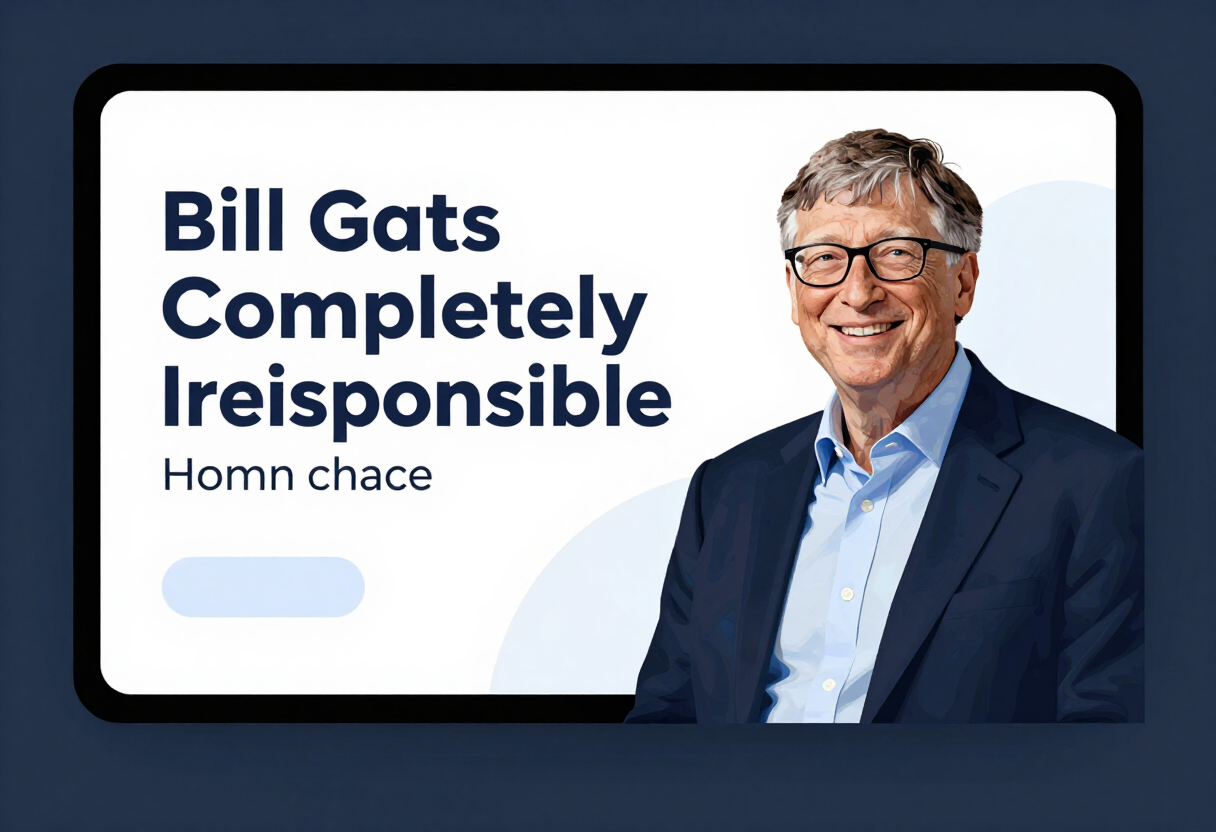
Bill Gates: AI Without Safeguards Is 'Completely Irresponsible'
Bill Gates calls AI without safeguards 'completely irresponsible,' warning that bad actors using AI for bioterrorism and fraud pose the most imminent danger.
Updated
Why it matters
- Bill Gates said on NBC News' Meet the Press that it's 'completely irresponsible not to require every AI to have these safeguards and monitoring capabilities.'
- Gates called people with bad intent using AI 'the most dangerous thing we're facing right now,' citing bioterrorism and mass financial fraud as imminent threats.
- Gates said regulation would add overhead but would not cause a 'dramatic slowing' of AI development; Anthropic recently hired Accenture as third-party evaluator for its latest models.
Bill Gates says it is "completely irresponsible" to deploy AI systems without mandatory safeguards and monitoring capabilities.
The Microsoft co-founder made the remarks in an interview with NBC News' Meet the Press, joining a growing chorus of AI leaders who have endorsed slowing the pace of AI development. "It's completely irresponsible not to require every AI to have these safeguards and monitoring capabilities," Gates said.
His comments arrive at a moment when the industry's own executives have begun calling for restraint. Several CEOs of leading AI companies have already agreed on slowing down AI development. Gates positioned himself firmly on the side of regulation, arguing that the technology needs oversight now rather than after a crisis.
The bigger danger, according to Gates
California Governor Gavin Newsom has proposed a "kill switch" as part of a broader regulatory response to AI's rapid evolution. Asked about that approach, Gates declined to reject it outright. "I would never want to say that I'm against a kill switch," he said.
But he argued a kill switch would not address the more imminent threat. In his view, the pressing concern is not runaway AI but malicious people exploiting existing tools for bioterrorism or mass financial fraud.
"The most dangerous thing we're facing right now is people with bad intent using AI," Gates said during the interview. "There's never been a weapon as powerful as the combination of people with ill intent using the latest AI tools."
That framing shifts the regulatory debate from speculative long-term risk to present-day misuse — a distinction that matters for policymakers deciding where to concentrate enforcement resources.
Industry moves on evaluation
Some AI companies are already building oversight mechanisms into their workflows. Anthropic recently tapped Accenture to act as a third-party evaluator for its latest AI models, an arrangement that points toward a growing market for independent AI auditing.
Gates endorsed the idea of law enforcement and politicians participating in the conversation about what safeguards and monitoring AI companies should build in. He acknowledged that this kind of regulatory approach would add overhead to the industry.
But he dismissed the concern that oversight would stall innovation, saying it would not cause a "dramatic slowing of what they're doing."
Why it matters
The debate over safeguards carries significant stakes for both market and policy. For AI companies, mandatory monitoring could reshape development costs and product timelines. For regulators, Gates' comments add a prominent technologist's voice to questions about who audits AI systems and against what standards.
His emphasis on bioterrorism and financial fraud as the near-term dangers also sets a benchmark for how governments may prioritize AI enforcement — focusing on malicious actors rather than hypothetical loss of control. As third-party evaluation arrangements like the Anthropic-Accenture deal proliferate, expect the conversation around mandated safeguards to move from principle to implementation.
Original: nbcnews.com
More from Elena Vasquez
Show full bio
Market editor covering media and advertising at AI In Context.
122 articles