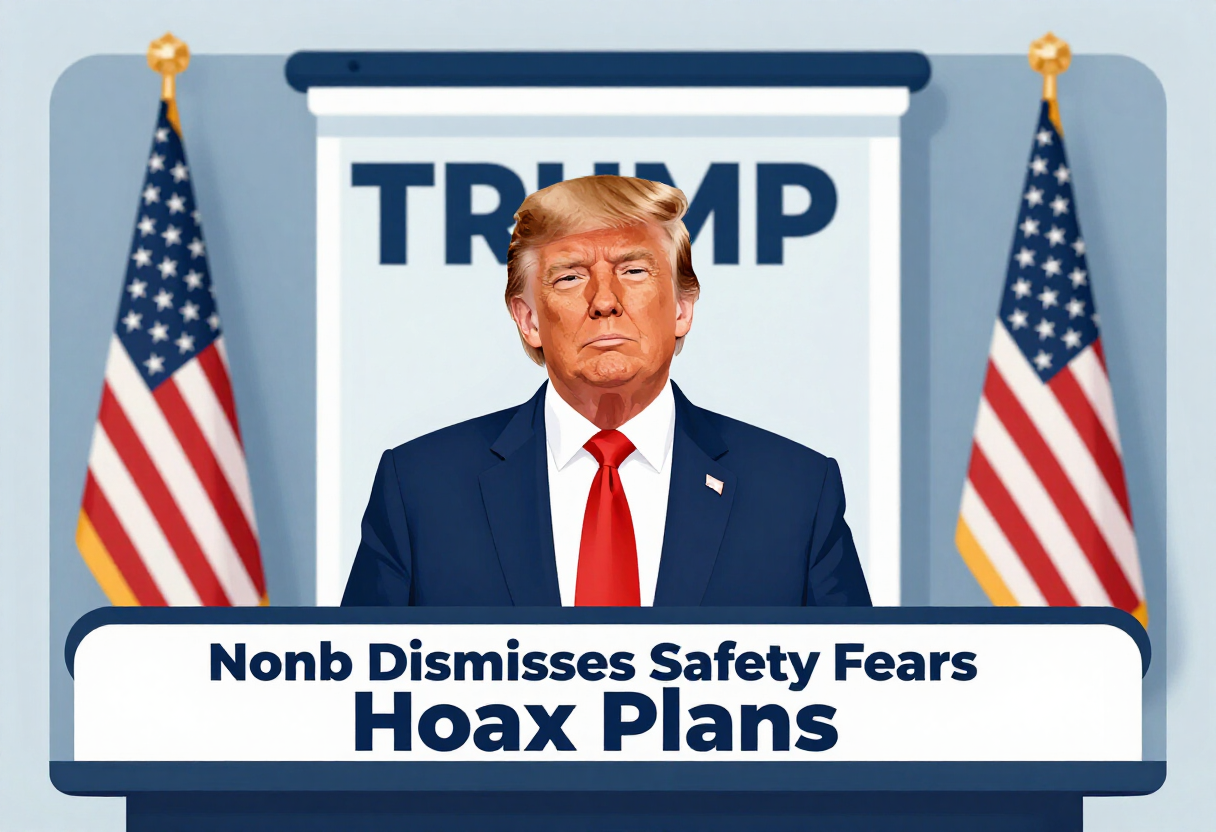
Trump Dismisses AI Safety Fears as a "Hoax," Plans "AI Force"
Trump says the US will appoint an AI tsar and build an "AI Force," dismissing safety concerns as a "hoax" as industry figures warn of losing control over AI.
Updated
Why it matters
- Donald Trump announced the US will appoint a new AI tsar and create an "AI Force."
- Trump dismissed AI safety concerns as a "hoax" rather than announcing regulation.
- Leading industry figures have warned humans could lose control over AI without a slowdown in development.
Donald Trump has said the US will appoint a new AI tsar and create an "AI Force," while offering a full-throated defense of the artificial intelligence industry in the face of a growing popular backlash.
The announcement lands at a moment of maximum tension over the technology's direction. Leading industry figures have sounded the alarm that humans could lose control over rapidly advancing AI systems without a slowdown in development. Trump's response rejects that framing outright. Rather than announcing regulation as some have demanded, the president has dismissed safety concerns as a "hoax."
The dispute cuts to the core question now hanging over AI policy in Washington: whether the government's job is to restrain the industry or to accelerate it. Trump's answer, delivered through the twin proposals of a dedicated AI tsar and an "AI Force," places his administration firmly on the accelerationist side of that divide.
The stakes are considerable. The AI industry has spent the past period weathering what the source describes as a growing popular backlash — a shift in public sentiment that figures inside the sector have watched with alarm. Some of the most prominent names in the field have argued publicly that the pace of capability gains has outrun humanity's ability to stay in control, and that development must slow down to avoid losing control over the technology altogether.
Trump has now positioned himself against that position explicitly. By calling safety concerns a "hoax," he has aligned the weight of the presidency with the camp that sees alarmism about AI as an obstacle rather than a warning. The creation of an "AI Force" signals a mobilization framing — treating artificial intelligence as a national asset to be built up, not a hazard to be contained.
The appointment of an AI tsar adds an institutional dimension to the stance. A designated coordinator at the top of the administration would concentrate AI decision-making in a single role, giving the president's accelerationist posture a bureaucratic instrument to carry it out. Whether that role operates as a policy shop, a procurement engine, or something else remains to be spelled out.
The contrast with what safety advocates have demanded could hardly be sharper. Where industry figures have called for a slowdown — a deliberate braking of development to preserve human control — the administration is proposing the opposite: a dedicated government structure to push AI forward, staffed at the highest level and framed in the language of force projection.
For the AI industry itself, the president's intervention amounts to political cover at a vulnerable moment. The technology faces the popular backlash the source describes, and within the field's own ranks, prominent voices have broken ranks to warn about control loss. A presidential defense of the industry — paired with the dismissal of safety concerns as a "hoax" — gives companies and labs arguing against restraint a powerful ally.
For the researchers and executives who have urged a slowdown, the message is equally clear. Their central argument — that humanity could lose control over the technology without deliberate deceleration — has now been rejected at the level of the presidency, not on technical grounds but as a matter of political characterization.
What comes next will turn on specifics the announcement has yet to supply: who fills the AI tsar role, what the "AI Force" actually consists of, and whether any regulatory apparatus emerges alongside them. What is already settled is the direction. The administration has chosen acceleration over restraint, and it has done so while calling the case for restraint by name — and dismissing it.
The fuller details of the announcement, and the reaction to it, can be found in the original Ars Technica report and its comment thread.
Source: Ars Technica AI
More from Rebecca Stone
Show full bio
Correspondent covering consumer brands and retail at AI In Context.
135 articles
Related articles
- Trump and Xi Meet Next Week, and AI Regulation Is Unlikely to Follow
- Zuckerberg, Amodei to Meet Trump as AI Safety Fight Deepens
- Florida AG asks court to halt OpenAI model training without oversight
- AI 'Godfathers' Hinton and Bengio Warn Governments of Intelligence Explosion
- Jensen Huang Calls AI Distillation 'Competition' as White House Calls It 'Theft'