Anthropic's Amodei to Dine With Trump as Pentagon Feud Deepens
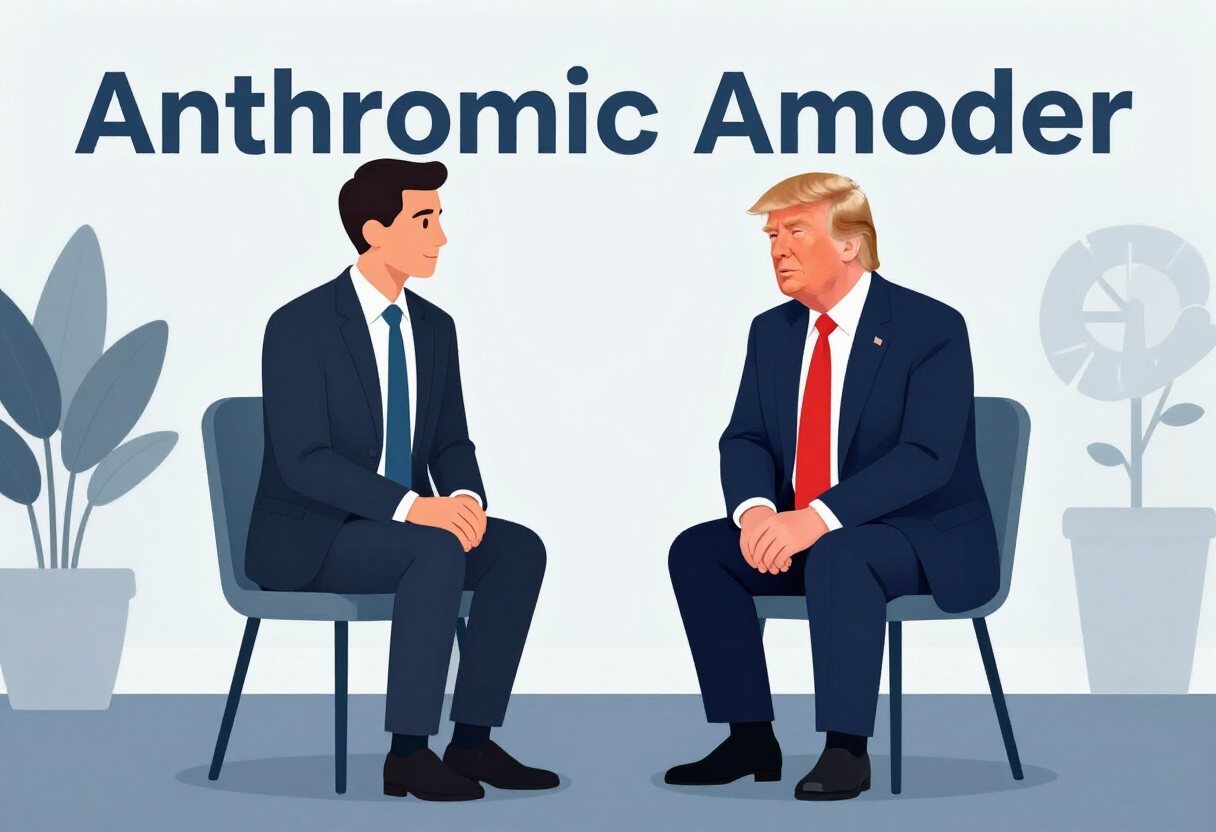
Dario Amodei meets Trump one-on-one for the first time, days after an appeals court upheld the Pentagon's unprecedented blacklisting of Anthropic as a supply chain risk.
Updated
Why it matters
- Dario Amodei will have a private dinner with President Trump at the White House on Sunday — their first one-on-one meeting, CNBC confirmed; Amodei missed Thursday's state dinner for Xi Jinping due to a scheduling conflict.
- A federal appeals court panel in Washington, D.C. on Friday upheld the Pentagon's designation of Anthropic as a supply chain risk, which blocks the U.S. military and defense contractors from using its models; Anthropic can still seek a rehearing or petition the Supreme Court.
- Trump attacked Amodei on Truth Social after the CEO's three-step proposal urging slower AI development and more oversight; Commerce Secretary Lutnick said Anthropic is "back on the right side" and "We trust Anthropic."
Anthropic CEO Dario Amodei will sit down for a private dinner with President Donald Trump at the White House on Sunday — the first one-on-one meeting between the two men, CNBC confirmed. The dinner lands at one of the most precarious moments in the company's history: days after a federal appeals court upheld the Pentagon's decision to blacklist Anthropic as a supply chain risk, and months before what is widely expected to be a blockbuster IPO.
Amodei was conspicuously absent from Trump's state dinner for Chinese President Xi Jinping on Thursday. The guest list read like a tech industry summit: OpenAI CEO Sam Altman, SpaceX CEO Elon Musk, Nvidia CEO Jensen Huang and Meta CEO Mark Zuckerberg all posed with government officials. Amodei had a scheduling conflict, according to a source familiar with the details who was not authorized to speak publicly, so Trump extended a separate invitation. Axios first reported the meeting.
The stakes for Anthropic could hardly be higher. The company has spent much of the past year in an openly strained relationship with the Trump administration, and Sunday's dinner offers Amodei a rare direct channel to the president at a moment when the Defense Department has locked Anthropic's models out of the U.S. military ecosystem entirely.
A White House framing on 'Super Intelligence'
The White House did not address the tensions when asked about the dinner. Instead, a White House official offered a broad statement in response to CNBC's inquiry.
"President Trump has been clear: America will lead the world in Super Intelligence, while protecting American consumers," the official said. "We will drive innovation, strengthen American competitiveness, and ensure this transformative technology works for the American people."
That framing sits uneasily beside Trump's recent public attacks on Amodei. Earlier this month, Amodei urged the AI industry to slow the pace of advanced model development and better address potential risks. He published a three-step proposal calling for additional government oversight. The proposal won support from other industry leaders, including Altman and Musk — but it angered the president.
"The only control or 'guardrails' that AI needs is a STRONG AND SMART (High IQ!) PRESIDENT, and the U.S.A. has that, in spades!" Trump wrote on Truth Social. "The Trump Administration has stopped AI 'people' from doing bad, or potentially bad, 'things,' like Dario (Anthropic!), who is now pretending to be a 'perfect little angel' - and we will continue to do so!"
The president's hostility predates the slowdown proposal. Amodei supported Kamala Harris in the 2024 presidential election and was a vocal critic of Trump, putting him at odds with an administration that has cultivated close ties with much of Silicon Valley.
A relationship that was mending — until it wasn't
Before Amodei's call for a development slowdown rocked the tech sector, Anthropic's standing with the administration appeared to be improving. Commerce Secretary Howard Lutnick, who temporarily imposed export controls on two of Anthropic's most advanced models in June, told Axios earlier this month that the company is "back on the right side." Lutnick also hosted a fireside chat with Anthropic co-founder Tom Brown at the G20 Innovation Ministerial in North Carolina.
"We trust Anthropic," Lutnick said on the sidelines of the event.
Brown has become Anthropic's primary conduit to the administration in recent months. As the company's chief compute officer, he reportedly led negotiations with the Commerce Department over its export control directive — a role Amodei previously held. The shift suggests Anthropic concluded that its CEO's public profile, damaged by his criticism of Trump and his safety advocacy, had become a liability in Washington.
The same day Lutnick spoke, White House Office of Science and Technology Policy Director Michael Kratsios told CNBC the administration was "in a good cadence" with Anthropic. He said the company was "open" and actively sharing its models with the government under Trump's voluntary AI executive order.
The Pentagon problem
That goodwill has not extended to the Department of Defense — and there, Anthropic just lost in court.
Negotiations between the company and the Pentagon collapsed in February after the two sides failed to agree on how the military could use Anthropic's models. The DOD demanded unfettered access across all lawful purposes. Anthropic wanted assurances that its technology would not be used for fully autonomous weapons or domestic mass surveillance.
The fallout was severe. The DOD labeled Anthropic a supply chain risk — an unprecedented move that implied the company threatened U.S. national security. The designation bars the U.S. military from using Anthropic's models and blocks defense contractors from using them in work with the agency.
Anthropic sued the Trump administration to reverse the blacklisting. On Friday, a federal appeals court panel in Washington, D.C., upheld the Pentagon's action. The company can still petition for a rehearing or ask the Supreme Court to take the case.
The ruling drew immediate celebration from the Pentagon's leadership. Emil Michael, the DOD's technology chief, posted on X: "The hammer of justice has smashed @AnthropicAI arguments. They are a Supply Chain Risk to the defense industrial base serving the @DeptofWar. Warfighters will sleep better knowing that no private company will insert their opinions in the chain of command. @SecWar was right!"
Defense Secretary Hegseth, who accused Anthropic of "duplicity" and of attempting "to strong-arm the United States military into submission" when negotiations collapsed in February, reaffirmed his position the same day.
"Confirmed: @AnthropicAI = Supply Chain Risk," Hegseth wrote on X. "The @DeptofWar does what is right for the Country and our Warriors."
Why Sunday matters
The dinner gives Amodei a direct line to the one official who could override the institutional machinery now arrayed against his company. Trump has already shown willingness to intervene in individual AI companies' fortunes, and the White House statement suggests the administration still sees political value in Anthropic's success as an American AI champion.
The context sharpens the stakes. Anthropic's competitors — OpenAI, Meta, xAI and Google — have moved aggressively to secure government business and presidential goodwill. Anthropic's safety positioning, once seen as a brand asset, has become a point of friction with an administration that frames AI dominance as a national priority and treats usage restrictions as insubordination. With an IPO on the horizon, investors will scrutinize whether Anthropic can rebuild federal revenue channels or whether the Pentagon designation hardens into a permanent competitive handicap.
Sunday's dinner will not resolve the court fight, the blacklisting, or the deeper disagreement over how AI models should be deployed. But it will test whether a single evening with the president can accomplish what months of negotiation, litigation and shuttle diplomacy by Tom Brown have not.
Original: axios.com
More from James Calloway
Show full bio
News editor covering industry trends and analytics at AI In Context.
119 articles