Universities Must Become 'Neutral Brokers' as AI Forces Mission Rethink
Panelists at THE's Innovation & Impact Summit 2026 in Seoul said universities must collaborate with industry and government from Day 1 — and warned institutional structures may lag behind AI.
Why it matters
- John Kao, president of National Tsing Hua University, cited Taiwan's semiconductor industry as decades-long cooperation among universities, government and companies.
- Kao said Kaohsiung's government supports his university's campus as the city seeks to transform traditional industries and attract higher-value businesses.
- Max Lu said innovation ecosystems require entrepreneurial skills, capital, infrastructure, connections and risk-reducing government policies.
- Sun Sun Lim described a mental health chatbot discussion uniting psychologists, social workers, technologists, policymakers and academics.
- Dolores Volkert of EIT RawMaterials warned that slow university structures risk lagging behind rapid technological change.
Universities must sit businesses, policymakers and scholars at the same table from Day 1 of research — or watch their discoveries stall before they become products, panelists argued at the Times Higher Education Innovation & Impact Summit 2026 in Seoul.
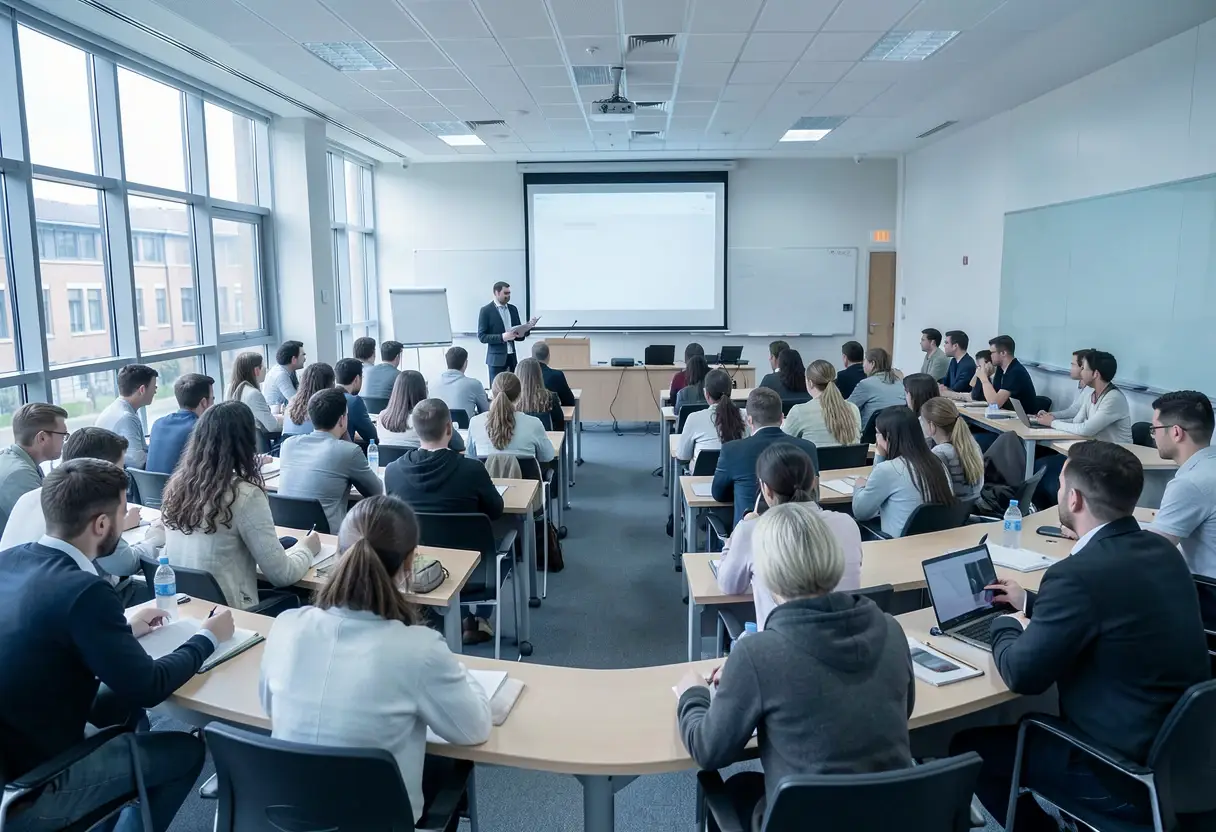
The session, titled "Higher education, industry and government: Achieving effective collaboration," took place on Tuesday at Korea University and was moderated by Korea Times President-Publisher Oh Young-jin. Its core claim was blunt: effective partnerships require far more than funding research and waiting for companies to commercialize the results.
Why does this matter now? Companies face challenges that reach beyond engineering — geopolitics, supply chain disruptions, energy use and sustainability — and universities, the panelists argued, are among the few institutions positioned to assemble expertise across those domains. The stake is whether publicly funded research translates into economic and social impact at all.
What does Taiwan's semiconductor model prove?
John Kao, president of National Tsing Hua University, offered Taiwan's semiconductor industry as his central case. That industry, he said, represents cooperation built over decades: universities nurturing students, government supporting industrial transformation, and companies building relationships across global supply chains.
"It's not just who can make the smallest chips, but the bigger picture," Kao said.
He cited concrete evidence from his own institution. The Taiwanese city of Kaohsiung supports National Tsing Hua University's campus there, and that support aligns with the city's ambitions to develop skilled workers and technology, transform traditional industries and attract higher-value businesses. The campus is not an isolated academic project; it is one strand of a regional economic strategy.
For such partnerships to succeed, Kao stressed, participants must first recognize that their priorities differ. Governments seek economic growth. Universities need resources and opportunities. Businesses want to remain competitive. The workable zone is where those interests align — and finding it takes time.
"It's not just about short wins, but long-term trust," he said.
The caveat is implicit in his framing: decades of trust-building is a slow asset, and not every region has Taiwan's timeline or its industrial base to draw on.
How do universities build trust across competing interests?
Sun Sun Lim, vice president for partnerships and engagement at Singapore Management University, said universities occupy a distinctive position as what she called an "honest, neutral broker" among groups with different interests and perspectives.
Her example: a discussion on mental health chatbots that brought together psychologists, social workers, technology specialists, policymakers and academics. The contrasting perspectives, she said, forced participants to weigh both the risks of the technology and the reasons people were already using it — a dual view no single sector would produce alone.
Such exchanges allow societal challenges to be examined beyond the interests of any single sector, Lim argued. That is the practical case for the broker role: it produces a fuller picture of a problem than any industry, government office or faculty can generate internally.
She called for structural changes to make expertise more mobile, including:
- faculty placements in industry;
- practitioners teaching at universities;
- policymakers sharing their experience in classrooms.
Lim added a demand aimed at universities themselves: they must demonstrate their value and respond more quickly to partners. Trust, in other words, is not just declared; it is earned through responsiveness — a standard many academic institutions, with their slow committee structures, will find demanding.
Is weak commercialization a research quality problem?
Max Lu, vice-chancellor and president of the University of Wollongong, rejected a common assumption. The difficulty of turning research into products and businesses, he said, is not necessarily a reflection of research quality.
Successful innovation ecosystems, according to Lu, combine several ingredients at once:
- entrepreneurial skills and culture;
- capital;
- infrastructure;
- connections;
- government policies that reduce risk.
Universities, he argued, need to become active participants in those ecosystems rather than assume their responsibility ends with a discovery. His words carried an edge of impatience with the handoff model.
"Not just thinking, 'Well, we have this wonderful research, can I just give it to you and you do it,' but actually working together from Day 1," Lu said.
The takeaway in plain words: research excellence and innovation output are separate variables, and only the ecosystem connects them.
Why does AI push universities to rethink their mission?
The panel turned to artificial intelligence, and here the positions hardened around a shared claim: AI is forcing universities to re-examine what their education is for.
Kao said National Tsing Hua University had conducted exactly that examination. The institution asked why it exists and concluded that its mission is to help everyone in its community achieve their personal best, whether by pursuing an interest or discovering talents they had yet to recognize.
"So we are really the only institution in the world with a mission to foster talent, to fulfill their fullest potential," he said. "I think with that in mind, we are not scared by AI."
That claim to uniqueness deserves scrutiny — most universities would describe their missions in similar terms — but it grounds Kao's larger argument: a university defined by human potential has a defensible role regardless of how capable machines become.
Lim framed the challenge from a different angle. AI's ability to assemble personalized learning experiences, she said, requires universities to examine what makes their education distinctive.
"So reinvention, to me, is the key challenge for universities in this AI-disrupted era," she said.
Does AI make universities more or less relevant?
Lu argued for more, not less. AI raises the value of universities' role in developing critical thinkers, he said, because machines can produce outputs but cannot supply judgment.
Education, according to Lu, needs to emphasize imagination, purpose, human judgment and empathy. Assessment, he added, should examine how students learn rather than just what they produced — a shift that would upend conventional examination culture.
"I think today, universities are going to remain ever more relevant in the era of AI, because it is critical for us to really educate the next generation to be critical thinkers at a higher level," Lu said.
What could stall the adaptation?
Dolores Volkert, head of strategic education initiatives at EIT RawMaterials, supplied the panel's sharpest warning. Institutional adaptation, she cautioned, risks lagging behind technological development — and the gap is a matter of tempo, not direction.
"What I'm worried about is the pace," she said, contrasting rapid technological change with "the very slow structures and processes we still see across universities."
That warning tempers everything the panel promised. The broker role, the ecosystem participation, the mission reinvention: all of it depends on institutions whose structures, by Volkert's account, change more slowly than the technology pressing them to change.
The panel's message, stripped of conference framing, is a wager: that universities can reinvent themselves fast enough to stay indispensable. Volkert's pace problem is the reason that wager remains open.
Source: feed.koreatimes.co.kr
More from James Calloway
Show full bio
News editor covering people, launches and day-to-day practice in artificial intelligence and machine learning at AI In Context.
722 articles
Related articles
- Over 300 Delegates From 40 Countries Gather in Seoul for THE Innovation & Impact Summit 2026
- 95 Percent of Organizations See No Measurable AI Gains, University Leaders Warn
- Samsung and SK hynix plan $590 billion fabs; university races to train 23,000 workers
- Incheon National University Turns Research Into Products, Prizes and Robots
- Elsevier's Chi urges focus and trust as AI pressures universities