Trump Renames AI "Super" and Brands Resisters "The Enemy"
President Donald Trump declared AI critics "THE ENEMY" on Truth Social in September 2026 as part of a campaign to relabel artificial intelligence as "super" — and several of the industry's largest companies have publicly echoed that frame.
Updated
Why it matters
- Trump declared AI critics "THE ENEMY" on Truth Social in September 2026
- Trump held an AI executives press briefing at the White House on September 29, 2026
- Meta Platforms CEO Mark Zuckerberg attended the September 29 White House briefing
- The administration is pushing "super" as the preferred term and "artificial" as a pejorative for critics
- Federal AI documents still anchor on "artificial intelligence" in executive orders, NIST frameworks, and procurement rules
By James Calloway
President Donald Trump declared AI critics "THE ENEMY" on Truth Social in September 2026, according to reporting from The Verge. He did so as part of a campaign to relabel artificial intelligence as "super." Several of the largest names in the industry have publicly echoed that frame.
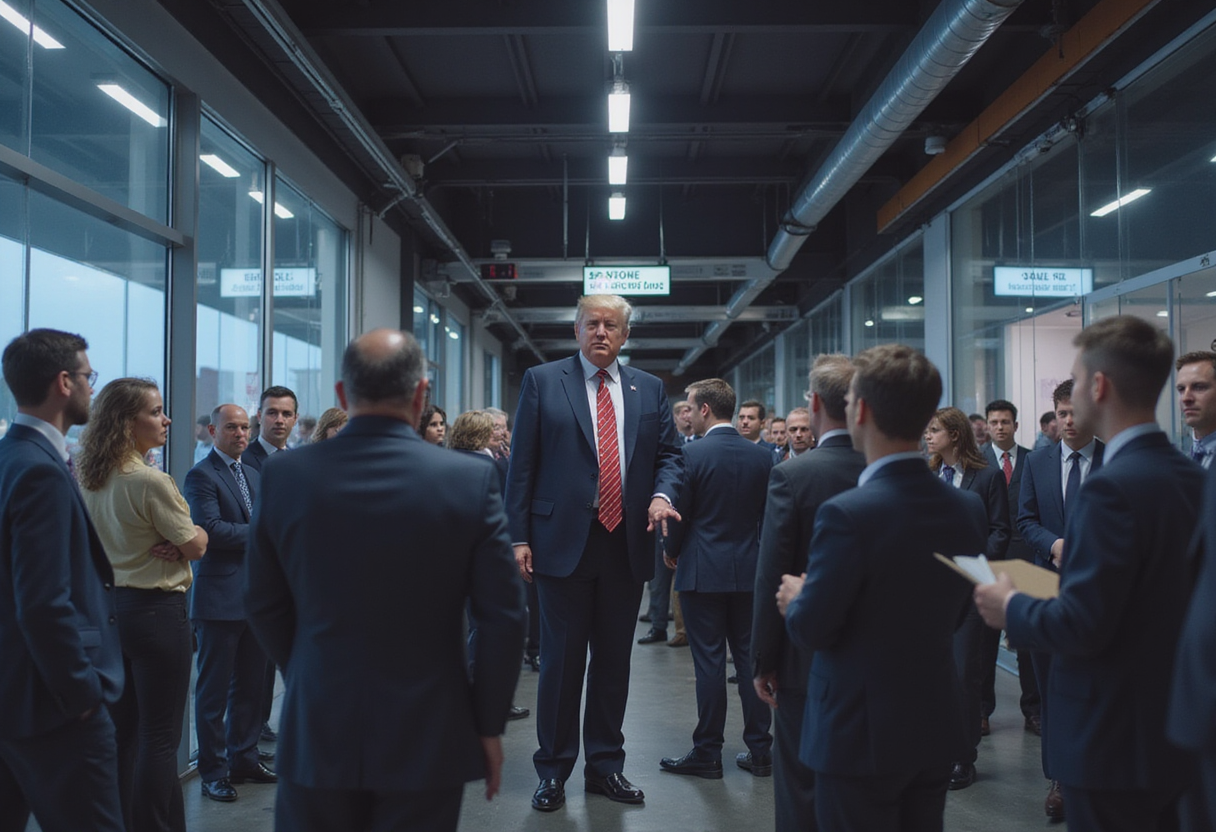
The campaign reached its highest-profile moment on September 29, 2026. Trump held a press briefing with AI executives outside the White House West Wing. Meta Platforms CEO Mark Zuckerberg stood at his side. Other major industry figures joined a closed-door AI meeting beforehand.
The framing the administration wants is "super." The framing it wants retired is "artificial." The pattern mirrors Trump's prior rebrands of "Little Marco," "Crooked Hillary," and "fake news" — each term lifted from its original context and turned into a political weapon.
The stakes: "artificial intelligence" still anchors U.S. federal research, procurement, and export-control documents. Whoever sets the vocabulary sets the boundaries of the regulatory conversation.
What's the linguistic strategy?
Trump has spent a decade turning neutral terms into political weapons. "Fake news" once described scammy content mills. He expanded it into a label for the entire mainstream press. The playbook now applies to AI policy.
The rebrand operates on two fronts. "Super" connotes power, speed, and American competitive advantage. "Artificial" connotes fraud, fakery, and weakness — shorthand for dismissing critics.
The caveat: rhetoric does not rewrite regulation. Until the Office of Management and Budget (the executive branch agency that sets federal administrative policy) updates its terminology, "artificial intelligence" remains the official term of art across the federal government.
The takeaway: vocabulary is doing policy work that statutes have not done.
Who's playing along?
Some of the biggest names in AI have publicly adopted the "super" framing. The full roster of executives at the September 29 briefing is not enumerated in the available reporting.
Industry leaders tend to echo the vocabulary of whichever administration controls federal contracts, export licenses, and procurement budgets. During the Biden administration, "responsible AI" dominated corporate press releases. Under Trump, "super" is rising.
The unspoken part: companies that adopt the preferred vocabulary gain favor with regulators. Those that resist face political risk. Speech is cheap, but federal access is not.
The takeaway: vocabulary alignment is a quiet form of compliance.
Why "super" and why now?
The term aligns with Trump's stated goal of accelerating AI deployment. He has framed AI as a national security asset and an economic engine. "Super" reinforces both readings in a single word.
The label also matches industry marketing. Frontier labs (the small group of companies building the largest generative AI models — systems trained on massive datasets to produce text, images, and code) already use "superintelligence" in product pitches. The White House vocabulary gives those pitches a federal stamp.
The takeaway: industry and administration are co-authoring the new frame.
What changed on September 29?
The White House briefing on September 29, 2026, was the rebrand's most visible expression to date. Trump met with AI executives in a closed-door session. He then addressed reporters outside the West Wing alongside them.
Mark Zuckerberg appeared on stage. The image — the Meta CEO standing beside the president — circulated widely. It signaled industry alignment with the administration's preferred vocabulary and its political posture toward AI.
The caveat: a photo op is not a contract. No company has publicly committed to rename products, retire "artificial intelligence" in technical work, or change research terminology.
The takeaway: presence at a White House stage is symbolic, not binding.
What's missing from the picture?
Available reporting does not list every executive at the September 29 meeting. It does not specify which companies have formally adopted "super" in their branding. It does not detail what concrete policy outcomes the White House tied to the vocabulary shift.
The skeptic's read: the gap between rhetoric and policy is itself the story. Trump can rename what he wishes, but federal rulebooks, academic journals, and engineering standards operate on slower clocks. Vocabulary alignment at a press conference does not translate automatically into procurement language or technical guidance.
The takeaway: until the gap closes, "super" is a slogan, not a statute.
How does the rebrand touch actual policy?
Federal AI policy in 2026 still uses "artificial intelligence." Several official channels anchor the term:
- Executive orders signed since January 2025
- NIST frameworks (the National Institute of Standards and Technology's published technical guidance for AI risk and safety)
- Federal procurement rules and contract templates
If the administration wants "super" to carry legal weight, it must update those documents. Until then, the word is a slogan without statutory force.
The caveat: the National AI Initiative Office, the Office of Science and Technology Policy, and the Department of Commerce all retain statutory language built around "artificial intelligence." Each would require formal revision.
The takeaway: the next test is whether "super" appears in formal federal guidance. If it does, the rebrand is policy. If it does not, it is performance.
What does industry stand to gain or lose?
AI companies face three paths:
- Echo the administration's vocabulary and buy goodwill
- Keep "artificial intelligence" in technical writing and risk being labeled critics
- Split the difference — use "AI" in research and "super" in marketing
The calculus favors compliance. Federal contracts in defense, intelligence, and infrastructure depend on political alignment. The cost of using the wrong word is small. The cost of losing a contract is large.
The caveat: vocabulary compliance does not guarantee policy favor. The administration can still impose export controls (limits on sales of advanced technology to foreign buyers), compute restrictions (caps on access to specialized AI hardware such as top-tier GPUs — the chips used to train and run frontier models), or safety mandates regardless of corporate speech.
The takeaway: companies buy access with words, but not necessarily protection.
What do researchers and standards bodies do?
Academic journals still require authors to write "artificial intelligence" in submissions. The AAAI (Association for the Advancement of Artificial Intelligence), the IEEE (Institute of Electrical and Electronics Engineers), and the ACM (Association for Computing Machinery) all maintain that term in their nomenclature.
International counterparts complicate the picture. The European Union's AI Act uses "artificial intelligence" throughout. The OECD AI Principles use the same term. Bilateral coordination on AI safety typically defaults to the established vocabulary.
The caveat: a U.S. administration cannot unilaterally rename a globally standardized term. Researchers, regulators, and trade partners abroad will keep using "artificial intelligence" regardless of White House preference.
The takeaway: the rebrand is bounded by international consensus and academic inertia.
What's the forward read?
Expect "super" to migrate into executive orders, congressional testimony, and federal procurement language if the AI agenda gains legislative traction in 2027. Expect companies competing for federal dollars to mirror the term. Expect critics and academic researchers to keep using "artificial intelligence" as a quiet act of professional defiance.
Vocabulary tests will become loyalty tests. Companies that adopt "super" early buy access. Companies that hold the line keep their independence. The market and the regulatory machinery will sort them out over the next twelve months.
The forward read: the question is not whether "super" replaces "artificial" in conversation — it already does. The question is whether it replaces "artificial" in law.
Original: journalism.org
More from James Calloway
Show full bio
News editor covering people, launches and day-to-day practice in artificial intelligence and machine learning at AI In Context.
247 articles
Related articles
- Trump Declares AI Renamed 'Super Intelligence' as Poll Numbers Sink
- Silicon Valley Lines Up Behind Trump's Push to Rename AI "Super Intelligence"
- Trump Dismisses AI Safety Fears as a "Hoax," Plans "AI Force"
- Microsoft's Nadella Adopts Trump's "Super Intelligence" Term
- Trump Says US Is 'Officially' Renaming AI to 'Super Intelligence'