Runware wants to build AI data centers on a car-style assembly line
Runware plans to scale its Romanian factory to 30 megawatts of modular data center capacity per day by 2028, backed by $1 billion in committed interest for its Sonic pods.
Why it matters
- Runware targets 30 megawatts of pod capacity per day by 2028, nearly 1 gigawatt per month.
- The company says it has received $1 billion in committed interest for Sonic pods, over 20 megawatts, in one month.
- Runware has raised over $60 million; its second Romanian factory goes online early next year.
- Pods are designed to come online within 48 hours of installation; build time is dropping from three weeks to one day.
- Runware's site pipeline covers 397 megawatts, expandable to 1.2 gigawatts.
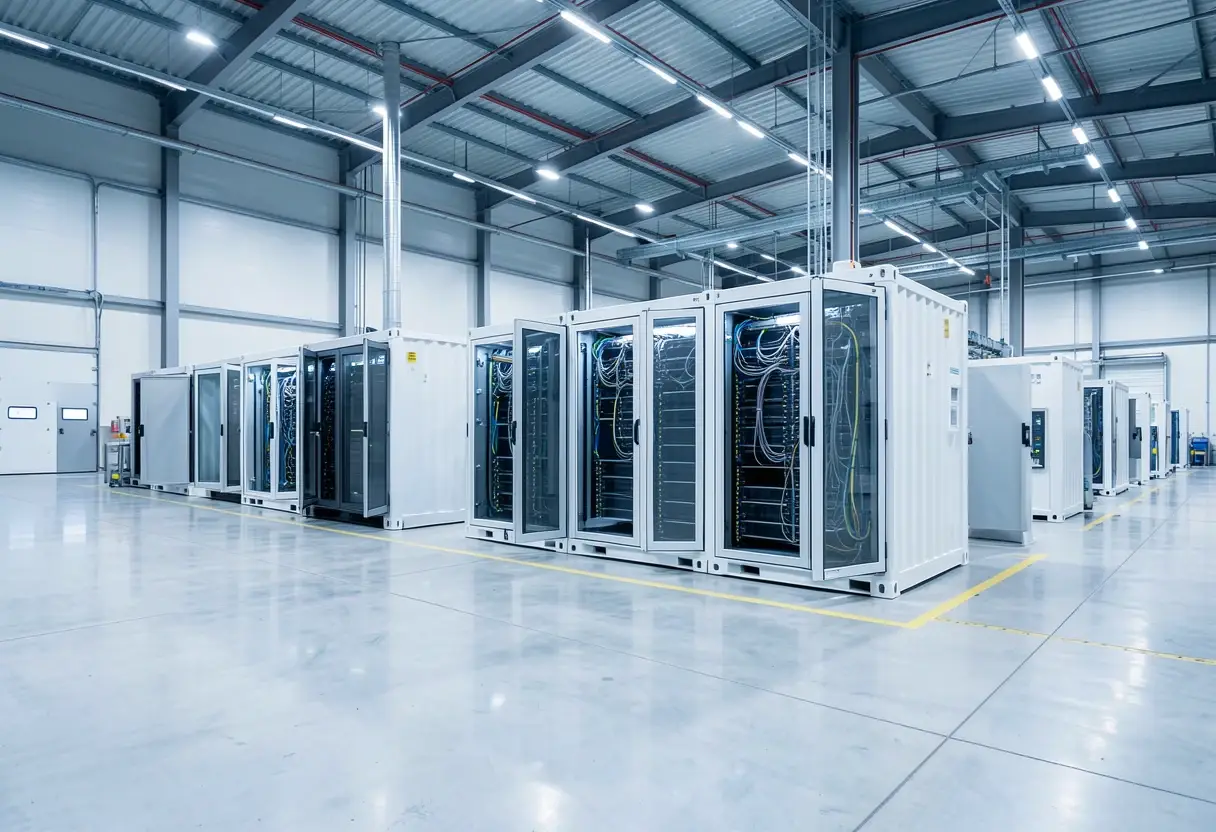
Runware says it wants to produce 30 megawatts of data center capacity every day by 2028 — roughly 1 gigawatt a month — from a factory in Romania that assembles modular AI data centers the way automakers assemble cars. The company shared the plan with TechCrunch just months after unveiling its Sonic Inference Pod, a factory-built data center shipped to customers ready to install.
That pace matters because of scale. At roughly 10 gigawatts a year, Runware's stated output would match what the entire United States was expected to add in data center power this year. It's an aggressive target, and it reflects a wider industry race to deploy AI infrastructure faster and more efficiently.
What is Runware actually building?
The core product is the Sonic Inference Pod, a modular data center with a standard design that can be configured to customer requirements and the latest GPU chips. Runware isn't the first to sell prefabricated pods — Crusoe and Schneider Electric offer them too — but the company claims it can ship faster than its competitors.
Runware already operates two factories in Romania. It has used one for a few years to build the pods, and it started building a second earlier this year. Radulescu told TechCrunch the second factory should be finished within months and come online early next year, with production ramping up gradually starting next year.
The pods will be manufactured on an assembly line. Customers can provide their own site, or Runware will find one for them. Once a pod arrives, Runware aims to bring it online within 48 hours — that's installation and setup time, not build time. Building a pod once took three weeks; the company says that will soon drop to one day as production ramps up.
The commercial model is flexible. Runware will provide spare parts when components fail, and customers can either rent compute from the company or supply their own GPUs and pay a monthly fee for the pods and operations. Power and internet are billed separately.
The takeaway: Runware wants to turn data center construction from a years-long building project into a factory product you order, receive and switch on within days.
Why does the factory approach give it an edge?
Chip supply, counterintuitively, works in Runware's favor. GPUs can take a long time to arrive after they're ordered — longer than Runware's pod delivery times, according to the company.
"Our pod delivery times are also shorter than current GPU lead times, giving us time to adapt the infrastructure to the hardware being ordered," Radulescu said. "For new GPU generations, our in-house hardware team can design, build, and test components itself, allowing us to adapt quickly."
Nvidia is pushing in a similar direction. Earlier this year it announced the Vera Rubin AI factories and the DSX POD, both designed to make it faster and easier for companies to build their own AI data centers. The difference, Runware argues, is that it has actually built a factory rather than just designed infrastructure blueprints for others to build.
The company says it has real demand behind the plan. Since it began offering Sonic pods to outside customers a month ago, Runware claims it has received $1 billion in committed interest, "representing over 20 megawatts, which we're now working to deliver," Radulescu said.
Can it avoid the Arrival problem?
Mass production is hard, and tech startups have failed at it before. The clearest cautionary tale is Arrival, the electric vehicle startup once valued at over $13 billion, which struggled to mass-produce EVs cost-effectively compared with traditional plants.
Runware has raised more than $60 million to date. It plans to raise a Series B, but for now it is finishing and launching the factory on the $50 million Series A it raised last December.
Radulescu argued Runware's economics differ from Arrival's. "Our cost structure is very different," he said. "We do have headcount and materials cost. But our factory staff is cost-effective relative to the value of deploying compute for AI." He added that designing its own systems and buying widely available, affordable parts keeps costs down. Runware has also hired what he called "a highly experienced plant manager from the automotive industry" to work alongside the chief of hardware and "help us get that execution right."
Component sourcing remains a weak point. Runware designs and builds its own cooling and other pod systems from standard components, but some parts — pumps and fans — come from Germany, and the company still depends on Nvidia for networking.
The takeaway: the plan's biggest risk isn't the technology, it's whether a startup can run a lean mass-manufacturing operation without the cost blowups that killed Arrival.
How much energy do the pods need?
Data centers in the U.S. and abroad face growing criticism over their energy consumption and its strain on the grid and local resources. Runware says its pods only need power and an internet connection. They use a closed-loop liquid cooling system with air-cooled radiators to release heat, which means they don't require a water connection.
On the power side, Radulescu said: "We're working with power providers on a site pipeline covering 397 megawatts, with potential to expand to 1.2 gigawatts." The company is deliberately deploying on sites much smaller than those used by hyperscalers like Amazon, Microsoft, and Google — sites that typically already have power, so they shouldn't further strain the grid or disrupt communities, he said.
The pods run "completely silent up to temperatures of 86 degrees Fahrenheit," according to Radulescu. "We use energy from renewable sources whenever possible. We are actively working on expanding our network of energy providers and sites. We're aiming to have renewables as our main energy source."
What happens next?
The immediate milestone is the new factory coming online early next year, followed by expansion to the U.S. and other regions worldwide. Beyond that, Radulescu sees modular systems becoming "the standard for large AI deployment" — not a niche product but the default way big AI compute gets built.
"Customers should be able to plan a hyperscale data center around factory-built pods from the beginning and have it working in months instead of years," he said.
For now, these are plans, and execution is the test. The factory will need people, inventory, supply chain logistics, and money. If Runware hits its 2028 target, factory-built pods could reshape how the industry closes the gap between AI compute demand and data center supply — and if it doesn't, Arrival's story shows how quickly a manufacturing ambition can collapse under its own costs.
Original: runware.ai
More from Sophie Lindqvist
Show full bio
Staff writer covering regulation, policy and their impact on artificial intelligence and machine learning at AI In Context.
352 articles
Related articles
- NVIDIA to invest up to $100 billion in OpenAI for 10 gigawatts of AI infrastructure
- OpenAI and Broadcom to deploy 10 gigawatts of custom AI accelerators
- OpenAI, Oracle and SoftBank Add Five Sites to Stargate Buildout
- OpenAI and Oracle Commit to 4.5 GW of New Stargate Data Centers
- Google's Emissions Jumped 50% in 2024 to Feed Generative AI