Remedy Robotics Raises $62M Series B for AI Cardiovascular Robot N1
Remedy Robotics raised $62M led by DCVC to fund a pivotal UC trial and FDA progress for N1, its AI robotic platform for remote endovascular and stroke care.
Why it matters
- Remedy Robotics raised $62 million in Series B funding on November 16, 2026, led by DCVC.
- N1 is designed for more than 30 cardiovascular conditions and remains investigational, not available for sale in any jurisdiction.
- In October 2025, Dr. Vitor Mendes Pereira performed what Remedy calls the world's first fully remote neurointerventional procedures across two Toronto hospitals.
- WHO estimates cardiovascular diseases caused 19.8 million deaths in 2022, about 32% of all deaths worldwide.
- Partners include SVIN Mission Thrombectomy as exclusive robotics partner and the Australian Stroke Alliance, representing 40 health bodies.
Remedy Robotics raised $62 million in Series B funding on November 16, 2026 to advance N1, its AI-enabled robotic platform for cardiovascular procedures. DCVC led the round. The capital will fund a planned pivotal clinical trial with the University of California, advancement toward FDA approval for neurovascular intervention, and prototype N1 deployments across Remedy's clinical-partner network.
One constraint frames the entire story: N1 remains under development and is not available for sale or clinical use in any jurisdiction. Remedy ties its funding to clinical milestones rather than immediate commercial availability of N1.
Who backed the round?
New investors include UC Investments, the University of California's investment office, Skip Capital, and Australian pension fund Hostplus. Existing investors increased their backing: Build Collective by Tony Fadell, Blackbird, Divergent Capital, and KdT Ventures.
The UC Investments participation is not incidental. Remedy says it has worked with UC clinical experts since 2021 and plans to hold the pivotal trials across the university's network. The funding round and the trial pathway connect through a single institution.
Why does access to stroke treatment matter?
CEO and co-founder Dr. David Bell described the access problem in the announcement: "Endovascular intervention is the gold standard treatment for stroke and many cardiovascular emergencies, yet access remains limited to a small number of hospitals."
The numbers behind that statement are severe. The World Health Organization estimates cardiovascular diseases caused 19.8 million deaths in 2022, approximately 32% of all deaths worldwide, with 85% of those deaths due to heart attack and stroke.
A World Stroke Organization–Lancet Neurology Commission estimated stroke's annual direct and indirect global costs at more than $891 billion. Its 2017 assessment put healthcare expenses as high as $315 billion and lost income at $576 billion. Those figures combine treatment and rehabilitation with lost income, establishing the economic context rather than a market estimate for robotic intervention.
Remedy's platform targets supervised autonomy and remote operation to widen access beyond the small number of specialized hospitals that currently deliver endovascular care.
What does N1 actually do?
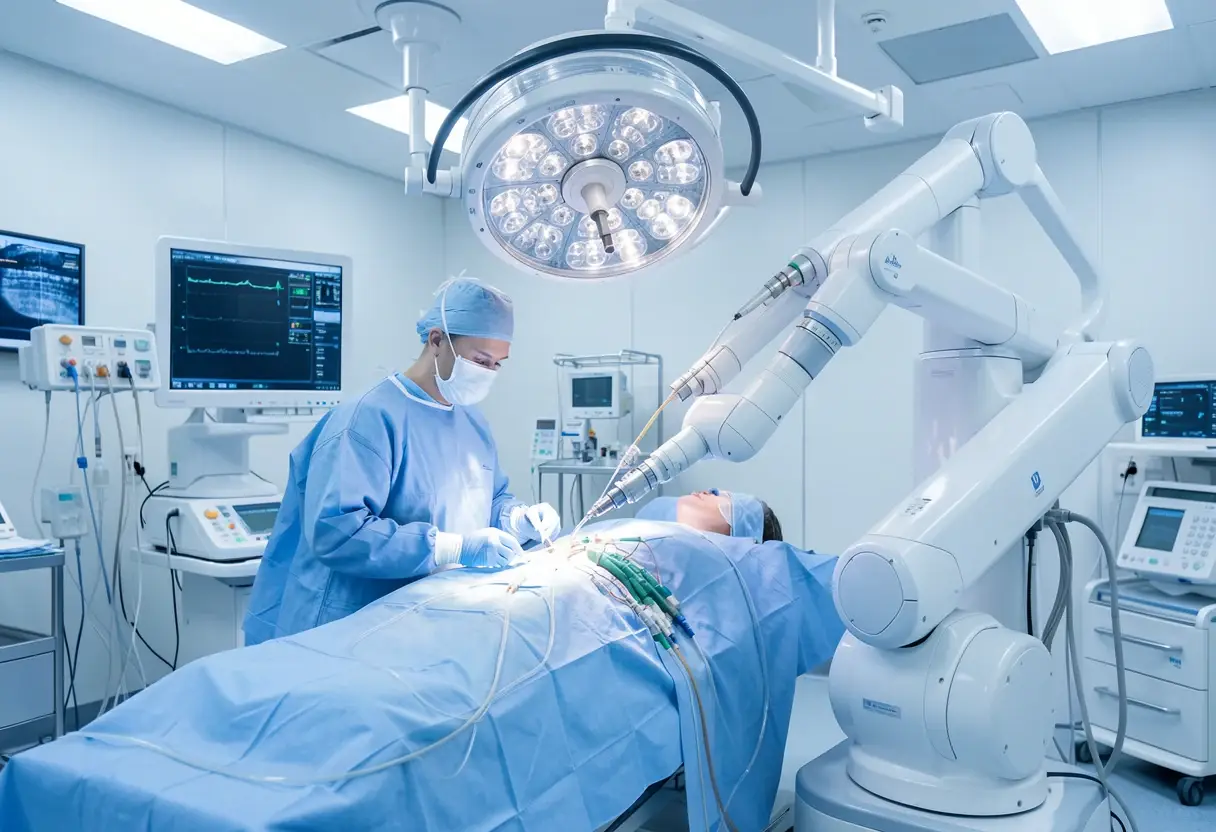
Remedy says N1 is designed to complete entire endovascular procedures (minimally invasive interventions through blood vessels) robotically, and to operate on site, remotely, or autonomously across neurovascular, coronary, and peripheral vascular care. The platform is designed for more than 30 cardiovascular conditions.
Its machine-learning software stack covers several layers of the procedure:
- Analyzing preoperative imaging before an intervention
- Simulating procedures in advance
- Providing real-time registration of three-dimensional images with two-dimensional procedural images, aligning the two views during an intervention
- AI-assisted control for off-the-shelf devices and proprietary 360-degree steerable catheters
- Automated imaging segmentation
Supervised autonomy is built on real-time understanding of tool and anatomy positioning. The remote-operation package includes connectivity management and audio and video without third-party integrations.
What happened in Toronto?
The company points to October 2025 as its proof point. Remedy describes those procedures as the world's first fully remote neurointerventional procedures. Dr. Vitor Mendes Pereira and his team operated entirely robotically from St. Joseph's Health Centre while patients were at St. Michael's Hospital across Toronto. No bedside interventionist was required.
That demonstration, not a regulatory clearance, is the current evidence base. The Series B announcement explicitly conditions N1's future on pivotal-trial evidence and FDA progress before the system can move from an investigational platform into routine clinical use.
How will the prototype deployments reach hospitals?
Remedy reports working with more than 100 hospitals worldwide. Its prototype deployments will run through two major clinical partners.
SVIN Mission Thrombectomy selected Remedy as its exclusive robotics partner for N1 testing, development, and global rollout. The second partner is the Australian Stroke Alliance, which represents 40 health bodies. That partnership spans clinical trials, regulatory approval, and a planned nationwide rollout across Australia.
These partnerships give Remedy routes for pivotal testing and eventual global rollout. They also tie the company's commercial future to institutions that already coordinate stroke networks rather than to individual hospital sales.
What are the stakes?
The company will use the new capital for four tracks: the pivotal clinical trial with UC, progress toward FDA approval for neurovascular intervention, prototype deployments through the clinical-partner network, and continued development of N1's AI and autonomous functions.
The sequencing matters. Remote procedures in Toronto, an exclusive partnership with SVIN Mission Thrombectomy, and a nationwide rollout plan with the Australian Stroke Alliance all depend on what the pivotal trials show. Until that evidence exists and the FDA process advances, N1 stays an investigational platform, and the $62 million funds the path between demonstration and routine clinical use.
Source: unite.ai
More from Marcus Bennett
Show full bio
Senior reporter covering companies, deals and strategy in artificial intelligence and machine learning at AI In Context.
718 articles
Related articles
- TestDynamics Raises $9 Million to Evaluate Medical Imaging AI
- Charta Health raises $55 million to expand AI chart review
- Science Corporation Raises $400M Series D to Scale PRIMA Retinal Implant
- Isomorphic Labs raises $5B to push AI-designed drugs into trials
- Isomorphic Labs Raises $5B as AI Drug Design Faces Trial Test