OpenAI Hires Former Slack CEO Denise Dresser as Chief Revenue Officer
OpenAI names former Slack CEO and Salesforce veteran Denise Dresser as Chief Revenue Officer, tasked with scaling enterprise revenue as AI adoption shifts from pilots to core business operations.
Updated
Why it matters
- OpenAI appointed Denise Dresser, former Slack CEO and Salesforce sales leader, as Chief Revenue Officer overseeing global revenue strategy across enterprise and customer success.
- OpenAI reports more than one million business customers, including Walmart, Morgan Stanley, Intuit, Databricks, Target, and Lowe's.
- OpenAI's State of Enterprise AI 2025 report found 75% of workers say AI improved the speed or quality of their work, with heavy users saving more than 10 hours per week.
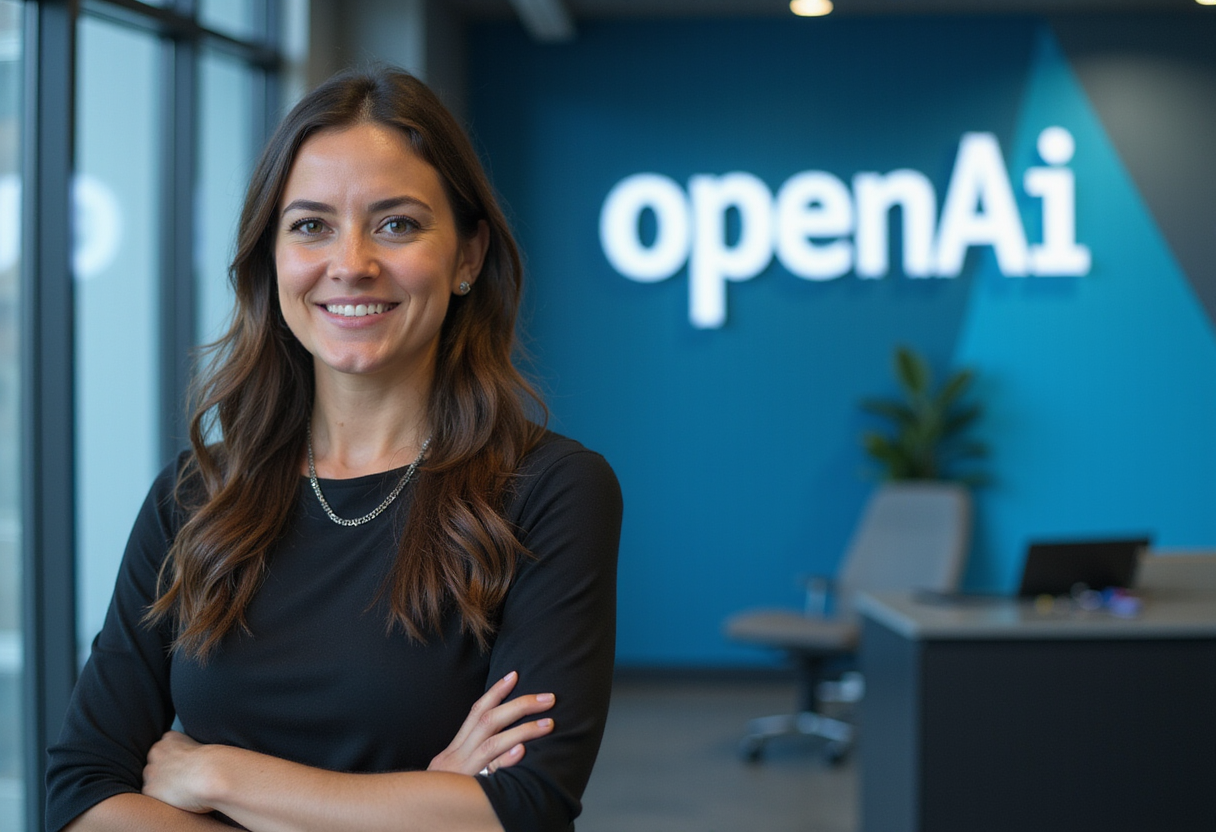
OpenAI has appointed Denise Dresser, the former CEO of Slack, as its Chief Revenue Officer, putting a seasoned enterprise software executive in charge of global revenue strategy across enterprise and customer success.
The company announced the hire on Wednesday, framing it as a milestone in its push to convert explosive consumer attention into durable business revenue. OpenAI describes itself as "the fastest-growing business platform in history," and Dresser's mandate is direct: help more businesses put AI to work in their day-to-day operations.
Dresser arrives with a résumé built for exactly this problem. At Slack, she led the company through its integration with Salesforce after the $27.7 billion acquisition closed, and she helped steer the workplace messaging platform through the early era of AI-assisted productivity. Before Slack, she spent more than a decade at Salesforce, where she built and led global sales organizations serving some of the company's largest and most complex customers.
That track record is what OpenAI is betting on. Fidji Simo, CEO of Applications at OpenAI, said in the announcement that Dresser has already led the kind of transformation OpenAI now wants to drive.
"We're on a path to put AI tools into the hands of millions of workers, across every industry," Simo said. "Denise has led that kind of shift before, and her experience will help us make AI useful, reliable, and accessible for businesses everywhere."
The appointment matters because OpenAI is racing to prove that its consumer-scale momentum can translate into enterprise contracts — the recurring, high-margin revenue that supports its business model as competition from Google, Microsoft, and Anthropic intensifies. Hiring a revenue chief with deep Salesforce and Slack roots signals that OpenAI sees the enterprise market as its next major growth engine, not a side business.
Why now
Dresser is joining at a moment when the market she will be selling into is changing shape. According to OpenAI's own enterprise research, companies are moving past single-use tools and pilots. They want AI they can depend on across their entire organization, powering their most important processes and applications.
The numbers behind that shift are striking. OpenAI's State of Enterprise AI 2025 report found that 75 percent of workers say AI has improved the speed or quality of their work. Many report saving 40 to 60 minutes per day. Heavy users save more than 10 hours per week. Three-quarters of users say they can now complete tasks that were previously out of reach.
Those figures come from OpenAI itself, which has an obvious interest in presenting enterprise adoption in the strongest possible light. But they align with the customer base the company now claims: more than one million business customers use its technology in customer experiences, internal operations, and daily workflows.
The roster of named accounts includes some of the largest companies in the United States. Walmart, Morgan Stanley, Intuit, Databricks, Target, and Lowe's all use OpenAI's technology, according to the announcement. Walmart, for instance, announced a partnership with OpenAI in October 2025 to build what it calls AI-first shopping experiences.
Selling on two tracks
OpenAI's enterprise motion runs on two parallel tracks, and Dresser will oversee revenue across both. The first is ChatGPT for Work, a product designed to let teams get started quickly without heavy integration work. The second is the API, which gives companies the ability to connect OpenAI's models directly into their own systems and build AI into their products and processes.
The two-track approach mirrors the strategy Dresser helped execute at Slack and Salesforce: meet customers where they are with ready-to-use tools, while offering deeper integration for those ready to build. It also reflects the practical reality of enterprise AI adoption in 2025 and 2026 — most companies still have employees using consumer-grade tools, and the revenue opportunity lies in moving them onto managed, organization-wide deployments.
Dresser herself framed the move in those terms.
"I've spent my career helping scale category-defining platforms, and I'm looking forward to bringing that experience to OpenAI as it enters its next phase of enterprise transformation," she said in the announcement.
A signal to the market
The hire reads as a signal in several directions at once. To enterprise buyers, it says OpenAI is building a sales and customer success organization that looks like the software vendors they already buy from — with leadership that understands multi-year contracts, procurement cycles, and organizational rollouts. To competitors, it says OpenAI is serious about winning the largest accounts directly rather than relying solely on partners. And to the market watching OpenAI's commercial trajectory, it underscores that enterprise revenue is now the company's central battleground.
Dresser's arrival also continues a pattern of OpenAI recruiting senior operators with deep enterprise software pedigrees as it matures from a research lab into a full-scale business. Fidji Simo herself joined OpenAI as CEO of Applications after serving as CEO of Instacart and, before that, as a senior Facebook executive.
The challenge ahead is substantial. Selling AI to enterprises in 2026 means addressing reliability, security, cost predictability, and organizational change management — not just model capabilities. Dresser's decade-plus at Salesforce selling to the world's most demanding customers, and her years steering Slack through both an acquisition and an AI transition, map closely onto that job description.
How quickly she can translate OpenAI's one-million-customer base into deeper, more entrenched enterprise deployments will be one of the clearest measures of whether the company's enterprise ambition matches its consumer success.
Original: images.ctfassets.net
More from Rebecca Stone
Show full bio
Correspondent covering consumer brands and retail at AI In Context.
157 articles
Related articles
- OpenAI Hires Instacart's Fidji Simo as CEO of Applications
- OpenAI Hires Instacart's Fidji Simo as CEO of Applications
- OpenAI's Enterprise Report: 1 Million Business Customers, 320x API Growth
- Intuit and OpenAI sign $100M+ deal to bring finance apps into ChatGPT
- OpenAI Puts $150 Million Into New Global Partner Network