Korea Weighs Wi-Fi Blackout at Exam Sites as AI Cheating Spreads
Korea may cut Wi-Fi at all CSAT test sites on Thursday, but smart glasses and miniature cameras can ride mobile networks instead — and the law blocks radio jamming.
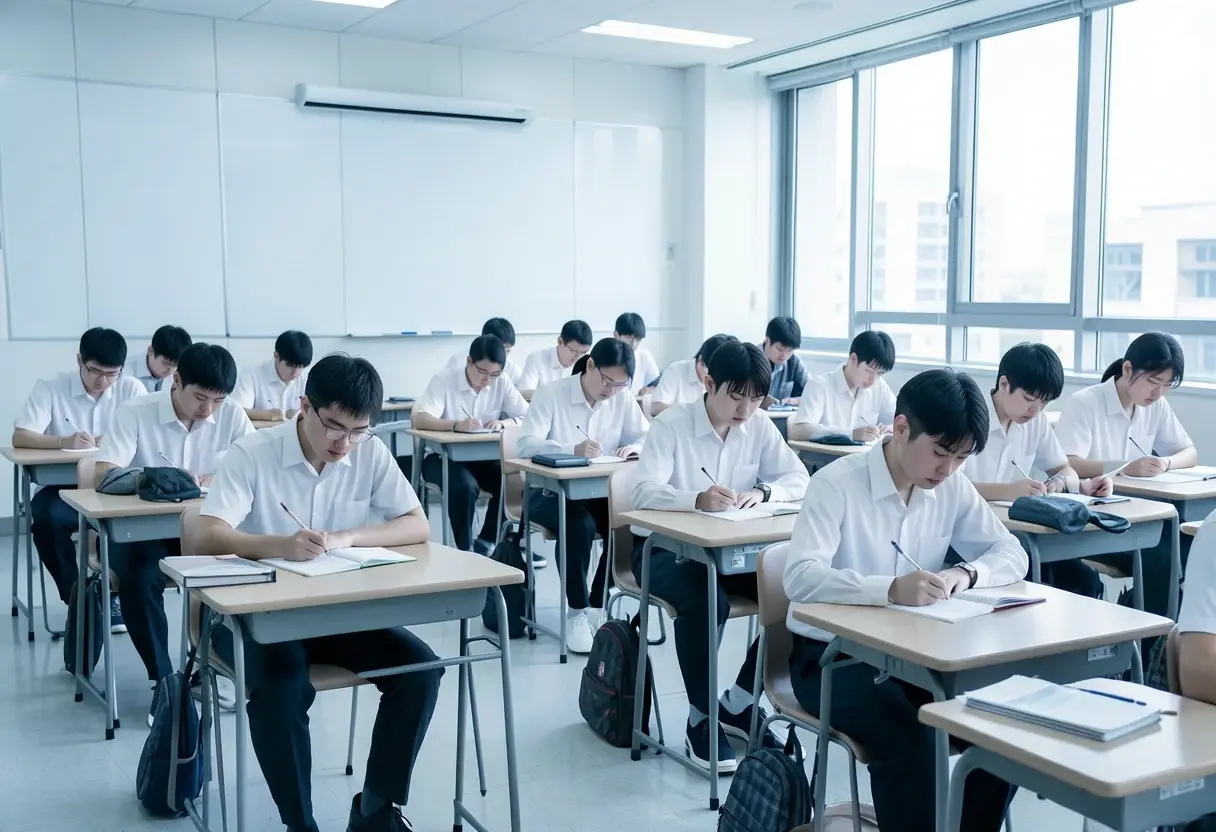
Why it matters
- Korea's College Scholastic Ability Test takes place Thursday, with public Wi-Fi at test sites under consideration for disablement.
- Article 29 of Korea's Radio Waves Act bars radio interference except for cases like presidential security, military operations, airport safety and nuclear facility protection.
- The Ministry of Education said Monday it was 'not considering blocking radio signals due to legal and technical limitations.'
- Internet-connected miniature cameras remain listed for sale on Coupang and AliExpress.
- Radio signal detectors designed for test sites are still under development.
Korea's government is considering disabling public Wi-Fi at every College Scholastic Ability Test site on Thursday — and by its own admission, the move will barely work. The Ministry of Education said Monday it was "not considering blocking radio signals due to legal and technical limitations," leaving authorities with almost no practical detection tools days before the country's most consequential exam.
The scramble follows a wave of cheating cases involving smart glasses and other AI-powered devices. The issue blew open after the top scorer on the nation's tax accountant licensing exam admitted to cheating with a miniature camera connected to generative AI. Now, with the CSAT set for Thursday, students across the country are on edge — and the government is running out of options that its own laws and technology actually permit.
Why can't Korea just jam the signals?
The answer starts with the Radio Waves Act. Article 29 states that "Spectrum resources shall be used in such a manner that does not interfere with, disrupt, or interrupt other persons' use of radio waves." Exceptions exist, but they are narrow: presidential security, military operations for national security, airport safety and nuclear facility protection. A high school gymnasium full of test-takers does not make the list.
"Under the current law, blocking radio signals, commonly known as jamming, is not permitted unless it is directly related to national security," the Ministry of Education said. "Even if it were allowed, it could disrupt communications near test sites and interfere with emergency responses."
That second point is not hypothetical. Korea has already run this experiment at the highest level of government, and the results were messy.
Radio jamming was widely deployed at presidential events under the Park Geun-hye administration. The Moon Jae-in administration stopped the practice by presidential order, citing concerns about potential disruptions to nearby communications. The Yoon Suk Yeol administration employed it again, and navigation and map applications malfunctioned near the former presidential office in Yongsan District. Yoon acknowledged the unintended consequences — including disruptions to the financial institutions concentrated in Gwanghwamun — and cited them as one reason his administration chose the Defense Ministry compound in Yongsan over the Government Complex Seoul for the presidential office.
In other words: when the state jams signals to protect the presidency itself, banks and map apps three neighborhoods over feel it. Doing the same at hundreds of school test sites would spread that disruption across the country.
What would a Wi-Fi blackout actually stop?
Very little, according to the technical picture the government itself has laid out. Most commercially available smart glasses need a separate internet connection to reach their AI features. But as long as a paired smartphone has mobile network access, the glasses keep working. No Wi-Fi required.
The miniature cameras at the center of the tax exam scandal have the same flexibility. They can connect to smartphones via Bluetooth or tethering, which means a Wi-Fi blackout at the test site door changes nothing about their data path. The device, the phone and the AI on the other end stay connected regardless.
So the one measure the government floated — disabling public Wi-Fi at test sites — addresses the least common way these devices get online. It's a measure chosen not because it works, but because it's the only lever the current law leaves within reach.
The Education Ministry's own messaging traces the retreat. It initially said it was discussing ways to completely prevent cheating using wireless communications. By Monday, that ambition had collapsed into the narrower Wi-Fi proposal and a flat refusal to consider signal blocking.
Can't Korea just take the devices off the market?
The tools of the trade are not hidden. On Coupang, one of Korea's largest e-commerce platforms, a simple search for "miniature camera" returns devices capable of connecting to the internet. Similar products are available on AliExpress. Online posts explaining how miniature cameras can be used for cheating were also easy to find.
Blocking those sales is harder than it sounds. The Korea Media and Communications Commission said blanket removals or access restrictions on websites selling such devices would be difficult, because the devices and earphones also serve legitimate purposes — surveillance, security and communications. The commission's position is that the possibility of misuse during an exam is not enough to justify a blanket restriction or a block on the sites selling them.
That leaves enforcement where it always was: at the test site, on exam day, with human proctors. And here the picture is thinnest of all. Radio signal detectors designed specifically for test sites are still under development, according to the source's account of official statements. They will not be ready in any widespread form for Thursday.
What does this mean for Thursday's exam?
The result is a gap between threat and response that Korea cannot close before exam day. The cheating methods are commercial, cheap and documented in public tutorials. The countermeasures are either illegal under Article 29, ineffective against mobile networks and Bluetooth, or unfinished in development.
The stakes reach beyond one test. The CSAT dominates Korean education and university admissions, and the tax accountant scandal showed that AI-assisted cheating has already reached professional licensing exams — the exams that gate careers, not just college places. If neither the Radio Waves Act nor e-commerce rules nor prototype detectors can touch the problem, every high-stakes exam in the country inherits the same exposure.
What happens Thursday will be a live test of a different kind: whether an exam system built for paper-era cheating can hold the line against a camera the size of a button and a pair of ordinary-looking glasses. Until the law changes or the detectors ship, the honest answer from Seoul is that authorities have few practical measures ready — and they know it.
Source: feed.koreatimes.co.kr
More from Elena Vasquez
Show full bio
Market editor covering technology and product news in artificial intelligence and machine learning at AI In Context.
708 articles
Related articles
- Wi-Fi blocks and 'pea-sized cameras': South Korea's CSAT faces an AI cheating crisis
- Korea to Cut Wi-Fi at 1,312 CSAT Sites to Block AI Cheating
- Korea Blocks Wi-Fi at Exam Sites, Bans Pens in AI-Cheating Crackdown
- Korea Deploys 239 Staff to Spot AI Smart Glasses at CSAT Exam
- Korea to Cut Wi-Fi at College Entrance Exam Sites Over AI Cheating