Tesla’s $99 FSD pitch for older drivers faces a safety evidence gap
Tesla markets FSD (Supervised) as safer mobility for older adults. Residents use it heavily, but researchers say senior adoption remains unknown and drivers must stay attentive.
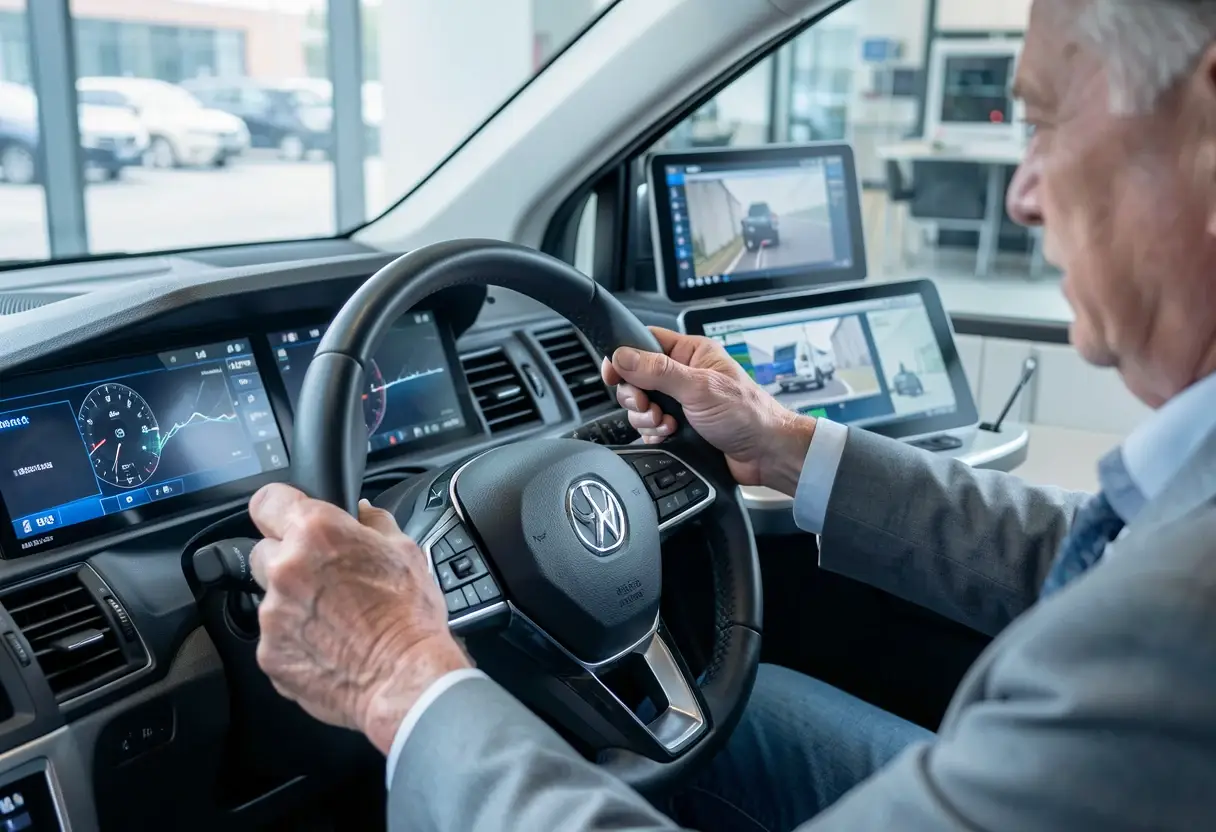
Why it matters
- Tesla lists FSD (Supervised) at $99 per month and requires a fully attentive driver.
- Fast Company reported a September 2026 Musk video featuring 98-year-old Larry and a July 2026 Tesla video featuring 93-year-old Lois.
- In a May 2025 forum account, one poster said about three-quarters of more than 100 Tesla Club attendees often used self-driving.
- The Detroit News reported 78-year-old Dick Amacher uses FSD 98% of the time and profiled 92-year-old Leonard Kraus in Maryland.
- Fast Company cited surveys finding three in 10 Americans with dementia continue driving.
By James Calloway
Tesla lists FSD (Supervised), its driver-assist software, at $99 a month, while its support page says the system “does not turn a Tesla into a fully autonomous vehicle.”
24/7 Wall St. compared that recurring fee with the 2027 Medicare Part B (federal health insurance) premium of $209.40 per month and an average retired worker’s Social Security check of about $2,071 after a 3.6% cost-of-living adjustment (COLA).
The stakes are older adults’ continued independence and whether driver-assist software can address age-related impairment without creating a new safety problem. Giving up a car can also mean giving up independent grocery runs, doctor visits and a weekly card game, 24/7 Wall St. noted.
In a November 20, 2026 report citing Fast Company, 24/7 Wall St. examined some residents of The Villages, Florida, a huge retirement community, who use Tesla’s supervised system on nearly every trip.
What is Tesla promising older drivers?
Fast Company reported that Tesla chief executive Elon Musk shared an in-car video in September 2026 featuring 98-year-old Larry. Larry said: “Look, I didn't have to look, you know! I don't want to look, it's just doing it.”
The remark captures the promise of reduced driver involvement. It also sits uneasily with Tesla’s support-page instruction that drivers remain fully attentive.
In July 2026, Tesla posted a video on X about Lois, whom Fast Company identified as 93. She had “noticed how tired she was on her daily drives.” Musk reshared it and claimed: “Tesla self-driving enables safer mobility for senior citizens.”
Tesla North America also featured a 71-year-old man who bought a Cybertruck “because my eyes are getting bad,” according to Fast Company. Fast Company characterized the promotion as “part of a pattern of boosterism.”
These cited examples consist of promotional testimonials, and the source provides no crash-rate comparison for them. In plain terms, the pitch offers independence, not proof of improved safety.
How widely do residents use FSD?
A May 2025 Talk of The Villages forum thread provides a self-selected snapshot of resident attitudes. Its posters are anonymous and do not give their ages, so their claims cannot establish how common supervised driving is among all older residents.
At a Tesla Club meeting with more than 100 attendees, Spectreron said about three-quarters raised their hands when asked who uses self-driving often. That figure comes from one poster’s account, not an independent survey.
The forum posts gave more specific accounts:
- RavenelRibet wrote, “I drive my Tesla Mod Y everyday, all trips in FSD.” They said drivers take over at community gates by lightly tapping the brake, then re-engage FSD once through.
- twoplanekid said they use FSD about 85% of the time, even though it “doesn't always drive (made the same choices) as I would.”
- USOTR said they use it 80% of the time and wrote, “The hardest part of owning a Tesla is learning the technology, then learning to trust it.”
- Another meeting attendee called Teslas “simply amazing vehicles” but wrote, “My hand did not go up. Do not have the need for FSD.”
Personal stakes appear alongside the usage figures. Nell57, who reported “macular degeneration… intermediate stage,” wrote: “I'm thrilled that self driving technology is continuing to improve so I'll be able to maintain my independence.”
Cpecka said that “with the increased shaking on my hands some day I won't be able to drive myself.”
Resistance was explicit. OrangeBlossomBaby wrote, “I don't trust other people behind the wheel, I'm certainly not going to trust a machine behind the wheel.” tophcfa asked, “Who will be held responsible when these things get into horrific accidents causing bodily injury and/or death?”
The pattern is not confined to Florida. The Detroit News reported that Dick Amacher, a 78-year-old retired General Motors engineer, drives his Teslas on FSD 98% of the time.
Amacher said: “It's as good a driver as I am. It will not go through a red light. It will not go through a stop sign.” The Detroit News also profiled Leonard Kraus, 92, who uses FSD in Maryland.
The evidence shows heavy use among interested owners, not typical adoption among older adults.
What does Tesla’s fine print allow?
Tesla’s support page defines FSD (Supervised) as “an advanced driver assistance system that is intended to be used only with a fully attentive driver.” It adds: “It does not turn a Tesla into a fully autonomous vehicle” and “You are responsible for the speed and control of your vehicle at all times.”
Fast Company said Tesla’s owner’s manual states: “You must remain attentive and be ready to take over at all times.” Tesla did not reply to Fast Company’s request for comment.
The $99 subscription adds a recurring monthly bill to retirement cash flows. 24/7 Wall St. compared the charge with Medicare Part B’s $209.40 2027 premium and an average retired worker’s roughly $2,071 Social Security check after a 3.6% COLA.
The operational boundary is narrow even when the marketing language sounds broad. A driver may use the system to assist with the trip, but Tesla says that person must watch the road, remain ready and retain control.
Tesla’s stated model depends on constant human supervision; convenience is the feature, not autonomy.
What do researchers know about senior use?
Birsen Donmez, a University of Toronto professor who studies human factors—the interaction between people and technology—told Fast Company: “If you can't drive yourself, you shouldn't be driving with FSD.” He said the name “could be misleading.”
Johnathon Ehsani of Johns Hopkins said: “The extent to which people are willing to adopt these vehicles, and ways that they're using them are completely wide open. We know nothing.” About Lois, he added: “Her feeling tired is a bit of a red flag.”
An Insurance Institute for Highway Safety spokesperson said such systems “should be considered convenience features rather than safety systems.” That distinction separates the assistance Tesla describes from the broader safety benefit Musk asserts.
Fast Company also cited surveys finding that three in 10 Americans with dementia continue to drive. The figure shows why families may seek an alternative to surrendering keys, but it does not establish whether FSD can safely replace a driver.
Fast Company reported a crash in a Trader Joe’s parking lot in California involving a 91-year-old driver that killed one person and injured five. The report said FSD use remained unclear, so the available evidence does not assign responsibility to the system.
The missing evidence is about human behavior, not just vehicle hardware: researchers do not yet know how older drivers will use or respond to FSD (Supervised).
What should families ask before relying on it?
Jennifer Crawley of the Maryland Department of Aging told Fast Company: “There's a grieving process that can occur when people give up the keys.” Her observation explains why an independence-preserving tool can carry such emotional weight for families.
The practical distinction is between assistance and replacement. Fast Company’s account suggests FSD (Supervised) may make a long drive less tiring for someone who can still drive safely, watch the road and take over immediately, including at community gates.
For a parent whose eyesight, hand tremor or memory has already made driving unsafe, Tesla’s manual and the researchers point in the same direction. The system does not restore the capacity to supervise the system.
The clearest test, drawn from the source’s guidance, is whether Dad could safely handle the car without FSD. If not, the source points to a need for another driver rather than a substitute for one.
The practical test is simple: can the parent drive safely without the software?
Can Tesla substantiate its safety claim?
Any stronger version of Musk’s promise will require evidence on older drivers’ actual behavior, including their willingness to remain attentive and their ability to take over. Researchers cited by Fast Company say those usage patterns remain unknown, while Tesla still places responsibility on the driver.
The next meaningful test for Tesla’s senior-driver pitch is data showing whether FSD (Supervised) preserves mobility without increasing risk. Until then, the company’s strongest evidence remains anecdotal, while its own manual limits the promise.
Source: 247wallst.com
More from James Calloway
Show full bio
News editor covering people, launches and day-to-day practice in artificial intelligence and machine learning at AI In Context.
791 articles
Related articles
- Tesla Sells First Private Cybercabs at $29,990 — Musk Calls His Own $299 Fee Too High
- Tesla Starts Selling Cybercab for Personal Use at $29,990 — With Fine Print
- Tesla Cybercab Buyers Need $299 Monthly to Keep It Running
- Tesla Opens Orders for a Steering-Wheel-Less Cybercab at $29,990
- Tesla faces more post-midterm scrutiny than SpaceX