OpenAI Lays Out Its Roadmap for the Next Phase of Enterprise AI
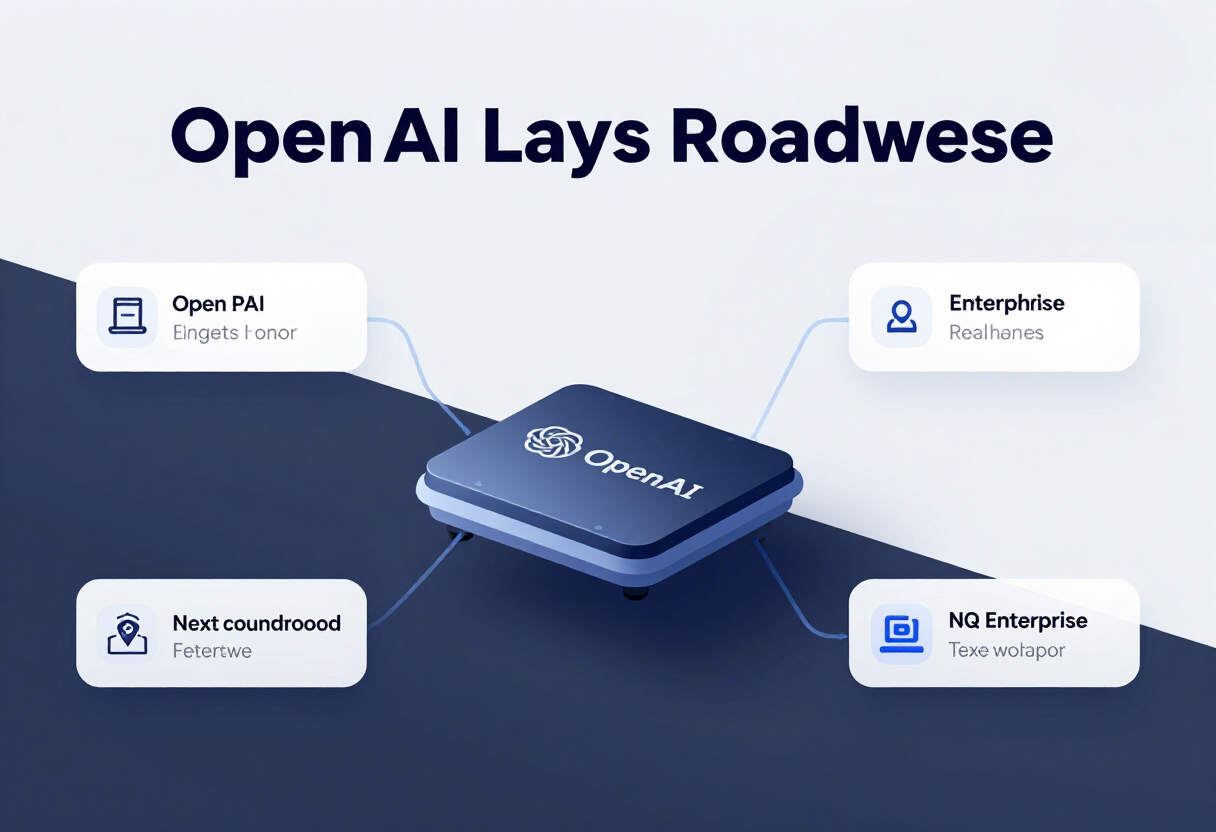
OpenAI maps the next phase of enterprise AI around four pillars — Frontier models, ChatGPT Enterprise, Codex and company-wide agents — as adoption accelerates across industries.
Updated
Why it matters
- OpenAI has outlined the next phase of enterprise AI built on four pillars: Frontier models, ChatGPT Enterprise, Codex, and company-wide AI agents.
- The outline states that AI adoption is accelerating across industries.
- Company-wide AI agents are positioned as the forward edge of the strategy, extending AI from individual assistance to organizational automation.
OpenAI has published its outline for what it calls the next phase of enterprise AI, staking its commercial future on four pillars: its Frontier models, ChatGPT Enterprise, the Codex coding platform, and company-wide AI agents.
The announcement arrives as enterprise adoption accelerates across industries. That is the core claim of the outline, and it frames OpenAI's argument that AI is moving from experimental pilots to infrastructure that runs inside the ordinary workflows of large organizations.
The stakes are straightforward. Enterprise contracts are the most lucrative and most defensible segment of the AI market. Businesses pay on multi-seat subscriptions, they renew annually, and they lock in ecosystems. Whoever defines what "enterprise AI" means over the next several years will set the terms for how the technology is procured, governed, and integrated across the global economy. OpenAI's outline is a bid to define those terms before its competitors do.
Four products, one strategy
The outline names four distinct offerings, and the structure of the list says as much as the products themselves.
Frontier models sit at the base of the stack. These are OpenAI's most capable systems, the models that businesses reach for when a task demands the highest available reasoning performance. For OpenAI, Frontier models are the research edge that everything else commercializes.
ChatGPT Enterprise is the distribution layer. It packages those models into a product that employees across a company can use under business-grade terms, extending the consumer product that made OpenAI a household name into procurement-approved deployment at organizational scale.
Codex targets software development, one of the earliest and most measurable enterprise use cases for AI. By naming Codex as a pillar of its enterprise strategy rather than a developer side project, OpenAI signals that it views code generation and engineering assistance as a primary enterprise workload, not a niche.
Company-wide AI agents are the forward edge of the plan. Where ChatGPT Enterprise puts a capable assistant in front of each employee, agents represent a different model of deployment: AI systems that act across an organization, executing multi-step work rather than answering single queries. OpenAI's decision to place agents alongside its established products in this outline marks them as the direction of travel, not a research curiosity.
Why the sequencing matters
Read together, the four pillars describe a maturity curve that OpenAI expects enterprises to climb. A company adopts Frontier models to solve hard, high-value problems. It rolls out ChatGPT Enterprise to give every employee a capable tool. It deploys Codex where the returns are most immediately measurable, in engineering. Then it extends agents across functions, moving from AI that assists individuals to AI that operates on the organization's behalf.
That progression mirrors how enterprise software has historically spread. Databases came first, then departmental applications, then company-wide platforms. OpenAI is arguing that AI follows the same pattern — and that its portfolio covers every stage of it.
The claim that adoption is "accelerating across industries" is the load-bearing fact in the outline. If AI adoption were still confined to pilots and experiments, a four-product enterprise strategy would be premature. Acceleration is what justifies the investment in agents and company-wide deployment, because those only pay off when an organization has already built the muscle to use AI routinely.
The competitive backdrop
OpenAI is not publishing this outline in a vacuum. Every major AI lab and cloud vendor is chasing the same enterprise budget, and the differentiators are narrowing at the model layer while widening at the product layer. A Frontier model alone no longer wins a contract; the winning vendor has to offer administration, integration, security posture, and a credible path from individual productivity tools to organizational automation.
That is precisely the ground OpenAI's outline covers. Frontier models answer the capability question. ChatGPT Enterprise answers the deployment question. Codex answers the workload question. Agents answer the automation question. The outline is a map of the four objections an enterprise buyer raises, with a product attached to each.
For buyers, the practical implication is that AI procurement is consolidating. Organizations that once stitched together point solutions for writing, coding, and analysis now face suites that promise all of it under one vendor relationship. That consolidation cuts integration costs and simplifies governance, but it also raises the stakes of the initial platform choice — because the vendor selected at the assistant stage is positioned to supply the agents later.
What to watch
The outline itself names the destination: AI agents operating company-wide. That is the phase of enterprise AI after widespread assistant deployment, and it is the one with the least precedent. Agents that execute multi-step work across an organization raise questions of oversight, accountability, and error handling that chat interfaces never did.
OpenAI's framing makes those questions the next frontier of enterprise AI in a governance sense as much as a technical one. The company that wins this phase will not just ship the most capable agents — it will be the one enterprises trust to let agents act. How quickly OpenAI moves from outlining agents to shipping them at company-wide scale, and how enterprises respond, will define the next chapter of this market.
Source: OpenAI News
More from Rebecca Stone
Show full bio
Correspondent covering consumer brands and retail at AI In Context.
135 articles
Related articles
- OpenAI Signs Big Four Consultancies to Deploy Its Frontier Agents
- OpenAI Launches Frontier, an Enterprise Platform for AI Agents
- OpenAI Puts $150 Million Into New Global Partner Network
- OpenAI to Sign EU Code of Practice, Launches European AI Rollout
- OpenAI Raises $122 Billion to Scale Frontier AI Worldwide