Oakland city workers vote 94.1% to strike over AI — and win protections
An Oakland union's near-unanimous strike vote forced AI protections into a tentative contract, part of a widening public-sector fight over bossware, autonomous vehicles and job displacement.
Why it matters
- Oakland's IFPTE Local 21 voted 94.1% on 22 October to authorize a strike over AI protections, then secured a tentative three-year deal that paused the 5 November strike.
- Nearly 70% of state and local government agencies say they have adopted or are implementing generative AI, per an Ernst and Young survey conducted July–August 2026.
- California Governor Gavin Newsom signed the No Robo Bosses bill and an AI workplace surveillance ban into law on 30 September.
- Pennsylvania, the first state to pilot OpenAI's ChatGPT Enterprise, agreed to a policy guaranteeing worker input and barring AI-driven discipline after SEIU Local 668 pushed Governor Josh Shapiro.
- New York's AI displacement law for state agency workers takes effect December 2025.
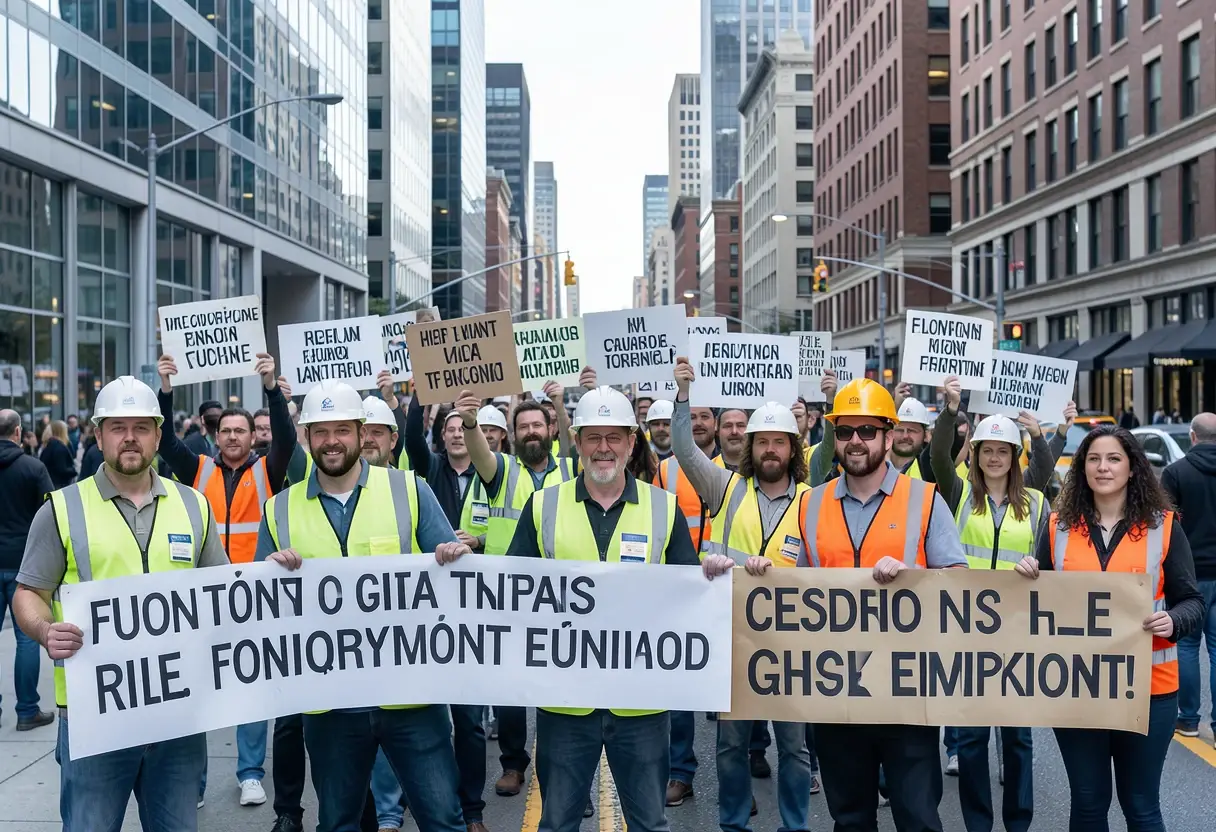
Oakland city workers voted 94.1% on 22 October to authorize a strike over AI-driven surveillance and job threats — and the near-unanimous vote worked: the city and the union reached a tentative three-year agreement with explicit AI protections, putting the 5 November strike on hold.
The tentative contract requires Oakland to retrain or reassign workers displaced by AI rather than fire them. It ends a confrontation that began when workers in the city, sitting in the shadow of Silicon Valley, worried the region would deploy AI systems that could increase surveillance and inaccurately evaluate their performance.
"We just want the city administration to really be intentional about how it's engaging with AI products," said Julian Ware, an Oakland spatial data administrator and member of International Federation of Professional and Technical Engineers Local 21. "Sometimes with a fancy new toy, it actually costs more, it's more difficult to implement and the results are not as good."
Why Oakland matters beyond Oakland
The Bay Area union is one of many public-sector labor groups nationwide seeking explicit protections against AI and automation, which union representatives say could worsen working conditions and threaten jobs. Following decades of automation efforts by companies and growing concern about AI since ChatGPT's debut in 2022, ongoing labor disputes reveal hardening battle lines between public-sector bosses and their workers.
The scale is already large. Nearly 70% of state and local government agencies say they have adopted or are implementing generative AI, according to a survey by Ernst and Young conducted from July to August 2026.
"The bosses have such zeal for use of this technology," said John Samuelsen, the Transport Workers Union president and a New York City subway track inspector. "Our members know that automation is the ultimate threat to their jobs … In transport, it's here, it's in our faces, we're fighting it every day."
Policy makers have moved too slowly, so workers must fight for themselves, argues Liz Shuler, AFL-CIO president and founder of its Technology Institute. "We're using our contract negotiations to institute guardrails that policymakers won't."
Some unions entered this fight prepared, having watched private-sector unions battle first, said Kung Feng, a researcher with the University of California at Berkeley's Labor Center and former director of San Francisco Jobs With Justice. In 2023, Communications Workers of America recommended AI protections and won some of them for California workers in October 2026.
"Workers versus billionaires has been the theme of this whole election … and bargain cycle," Feng said. "This is the contest that we have over the future of technology in the workplace."
What is 'bossware' — and where is it spreading?
Researchers call it bossware: AI tools that public- and private-sector employers are rolling out across industries to monitor and supervise employees, according to an October report Feng co-authored. The tools span a wide range of functions:
- Ranking and evaluating workers for hiring, firing and promotions
- Tracking location and activity
- Monitoring productivity
- Scanning biometrics for timekeeping
- Using cameras, wearable devices and sensors
- Leveraging analytics to predict emotions
Amazon has used algorithms to push warehouse workers to operate at dangerous speeds, and that strategy is now entering the public sector, said Lorena Gonzalez, the California Federation of Labor Unions president.
"We think AI doesn't belong on big-rig trucks, and it doesn't belong in hospitals and schools," Gonzalez said. Some automation could aid public-sector workers, such as vehicle safety systems in public transit, but humans should always remain in charge, she argued — pointing to aviation, where computers have flown planes for years yet every aircraft still carries two pilots who can override the system.
"If we're using a computer or AI, it has to be controlled by a human being, not the other way around," she said.
Public-sector employers often deploy automation in claimed attempts to improve efficiency and cut costs when budgets are slim, Feng said. Unions have pushed for AI protections since the late 2010s, and those battles intensify as generative AI spreads. Workers' demands include advance notice before new technology is rolled out, information about that technology, and the right to negotiate over its use.
How Pennsylvania and transit workers fought back
Last year, Pennsylvania became the first state to run a pilot program with OpenAI. The state encouraged employees such as unemployment claim workers and social workers to use ChatGPT Enterprise to test for time savings.
"But there were no guarantees or agreements for the workers," said Steve Catanese, president of Service Employees International Union Local 668, which represents more than 10,000 statewide public-sector workers. "With generative AI, workers are building their own gallows sometimes."
The union then spoke up, inspired by the California screenwriters' 2023 victory — one of the longest strikes in Hollywood history — which secured protections against AI replacing writers. SEIU Local 668 pushed Governor Josh Shapiro to agree to a policy guaranteeing that the state's use of AI will include employee input and supervision, and that the technology will not be used to discipline workers.
"It's powerful for elected leaders to say, there will always be human public servants under my watch," Catanese said. He expects these issues to resurface when the union negotiates a new contract in 2027.
In transportation, public workers in states including Florida and New York are proactively trying to block Waymo and city governments from deploying autonomous vehicles, calling them unsafe and a threat to jobs. They hope to replicate a 2024 victory in Columbus, Ohio, where the Transport Workers Union secured contracts giving it veto power over any Central Ohio Transit Authority plan to deploy autonomous vehicles.
The TWU does not oppose new technologies, Samuelsen said. It supports systems that aid collision avoidance and improve bus and train timing. But he worries industries are pushing AI without regard for safety — noting that some airlines have begun experimenting with drones to inspect aircraft from afar rather than relying on human jet mechanics, who can do more thorough, up-close inspections.
AI and automation are "in every single element of passenger transport, and even freight transport, that you can imagine. It has completely infiltrated us," Samuelsen said. "Where there's no … union that's willing to fight, workers are doomed."
What laws have already changed?
This is not the first time emerging technologies have damaged labor markets, union representatives said. "We've seen this movie before," Shuler said, citing the automation of midwestern assembly-line factories that reduced manufacturing jobs.
Some legislators, especially at the state level, are now acting:
-
The IFPTE and other unions supported California's No Robo Bosses bill, which bars employers from relying solely on automated systems to discipline or fire workers.
-
Unions also backed a California bill prohibiting workplace AI surveillance tools, such as those that could monitor employees' emotional states. Governor Gavin Newsom signed both into law on 30 September.
-
Public-sector unions in New York supported a law, effective December 2025, that protects workers at state agencies from being displaced by AI.
While tech CEOs have warned of AI's hypothetical risks to humanity, the more pressing issue is the harm employees face today, said Keith Brown, executive secretary-treasurer of the Alameda Labor Council, which serves public and private-sector workers in California's Alameda county.
"We've seen in the news a lot of headlines about the threat of AI destroying civilization," Brown said. "But for workers, we've been facing these harms from AI tech companies for a long time."
With Oakland's agreement as a template and contract talks looming in Pennsylvania in 2027, the negotiation table — not Congress — has become the place where AI workplace rules are actually being written.
By Rebecca Stone
Original: aviationweek.com
More from Rebecca Stone
Show full bio
Correspondent covering companies, deals and strategy in artificial intelligence and machine learning at AI In Context.
574 articles
Related articles
- California Governor Signs Laws Shielding Workers From AI Threats
- California's 'No Robo Bosses Act' bans fully automated firings
- Protesters Greet OpenAI DevDay With 'People Over Profit' Rally
- California bans 'robo bosses': Newsom signs first US law on AI firing decisions
- Laplace Intelligence uses AI to crash-test robots before reality does