Nvidia Shares Jump 31.5% as Jensen Huang Returns as CEO
Nvidia shares rose 31.5 percent Monday after Jensen Huang returned as CEO following Trump's lobbying, but congressional probes, lawsuits and circular-financing risks still hang over the company.
Why it matters
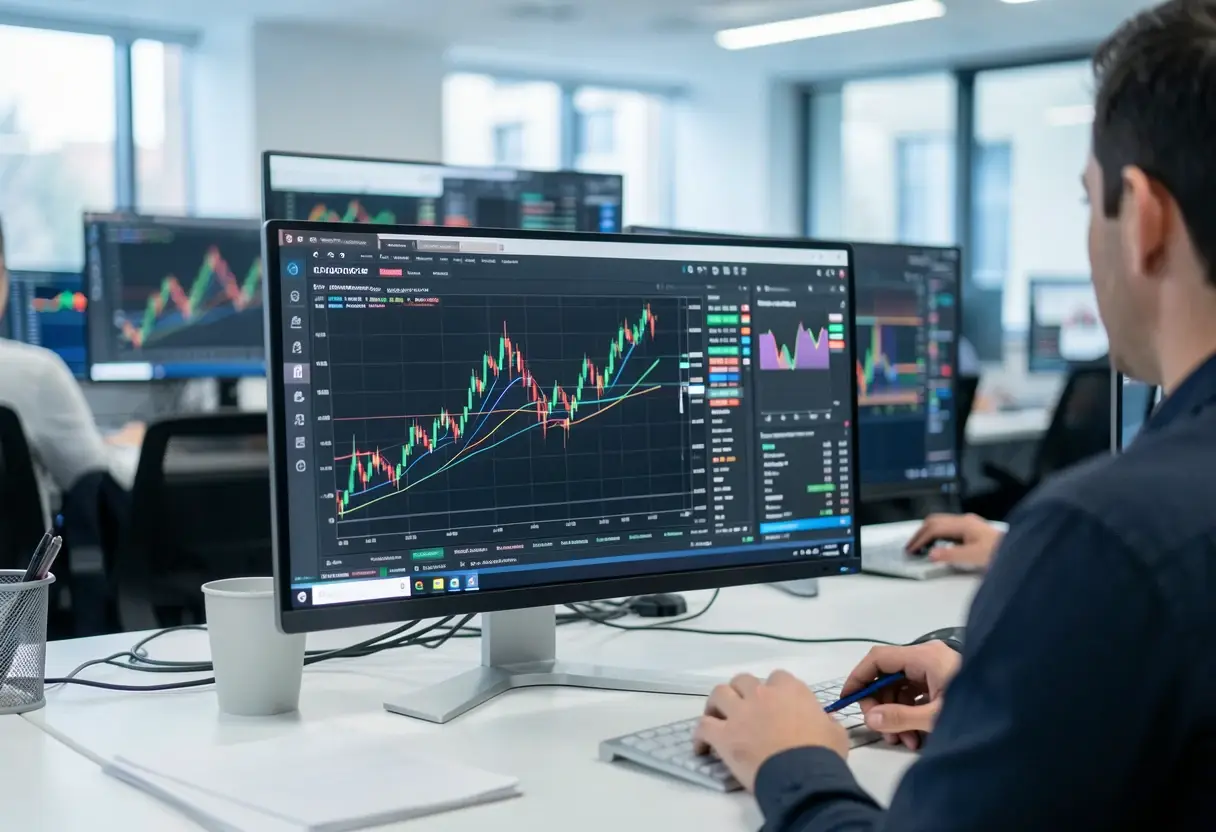
- Nvidia shares rose 31.5 percent on Monday after Huang's reinstatement; the stock had fallen by a third since Nov. 9.
- The S&P 500 dropped more than 10 percent from its high by Friday, then rose 4.7 percent on Monday.
- Huang acknowledged 'serious mistakes'; the board said government input assured it the reinstatement poses no national security risk.
- Nvidia warned in a recent report it may have no use for 'all the capacity we are committed to purchase.'
- Sen. Elizabeth Warren says her banking committee will investigate Nvidia's export-control compliance next year.
By James Calloway
Nvidia shares rose 31.5 percent on Monday after the company reinstated Jensen Huang as CEO, capping a week in which the stock had lost a third of its value and the S&P 500 had entered a market correction (a decline of more than 10 percent from a recent high). Huang's return, which followed open lobbying by President Donald Trump, calmed markets — for now. Congressional investigations, lawsuits, and a board-commissioned probe are still pending.
The episode tests a question with real stakes for the AI economy: can a company central to the industry's hardware supply tolerate a chief executive who likely violated its code of conduct, acknowledged an affair with a woman suspected of being a Chinese spy, and ran hundreds of millions of dollars of business on handshakes? Investors, at least on Monday, answered yes.
Employees chanted Huang's name as he returned to Nvidia headquarters. Whether the enthusiasm survives scrutiny is a separate matter.
How did the comeback happen?
Huang resigned on November 12. Almost immediately, a petition circulated in Silicon Valley, gathering employees and celebrity leaders — including SpaceX CEO Elon Musk — who argued for his return. Huang accepted the framing.
"I would be honored to answer these calls and return as CEO," Huang wrote on social media early last week, while acknowledging he had made "serious mistakes."
The company refused the offer at first.
Then Trump intervened. Nvidia stock was collapsing, down a third since November 9, and fears mounted that an AI bubble was popping. By Friday, the S&P 500 had fallen more than 10 percent from its recent high — the technical definition of a correction — after one of the worst weeks since the 2008 financial crisis.
"The board decided to do what we wanted them to do," Trump said on CNBC on Monday, describing his weekend lobbying. "I believe my intervention was very important."
The S&P 500 jumped 4.7 percent on Monday, recovering over half of the previous week's loss. Asked whether the falling market influenced his thinking on Huang's return, Trump told CNBC: "probably so."
Trump had earlier suggested the return should be celebrated by the "people of the United States — and, indeed, the World!"
Takeaway: the reinstatement was as much a market rescue operation as a corporate decision.
Why is Huang considered irreplaceable?
Silicon Valley's case for Huang rested on his dealmaking. Musk laid it out bluntly on X:
"Jensen drove supply chain brilliantly at Nvidia, but many of those deals were a handshake with Jensen, not a written contract. Without Jensen, at least some of those critical deals will be lost."
Huang ran Nvidia like a small business. He had roughly 60 direct reports and employed three family members, according to the report. He boasted of the approach himself, saying of TSMC, the Taiwanese company that manufactures Nvidia chips: "We don't have a contract, and that's pretty great."
Not everyone sees brilliance in the structure. Jeffrey Sonnenfeld, a leadership expert at the Yale School of Management, called it a liability.
"His lack of contracts for hundreds of millions of dollars of business is unparalleled in history — and there's no reason for it," Sonnenfeld said. He called the dozens of direct reports "absurd" and said the arrangement "made sure that nobody had the big picture perspective."
The same informality that supporters cite as proof of irreplaceability is, in this reading, a governance failure that concentrates all institutional knowledge in one person. Takeaway: Huang is hard to replace partly because he made himself the only person who could do the replacing.
What is circular financing, and why does it worry investors?
Huang also became essential to the AI economy by propping up Nvidia's own customers. Many AI companies buying Nvidia chips — including the newly public Anthropic — do not turn a profit and burn through cash quickly. Nvidia helped them buy its chips by striking deals to buy computing capacity and other services from them in turn.
These arrangements are called circular financing, and Nvidia itself has flagged the danger. In a recent report, the company warned it may have no use for "all the capacity we are committed to purchase." That is an unusual admission: the vendor is underwriting demand for its own product, and the vendor says it may not need what it ends up holding.
XTB analyst Kathleen Brooks wrote that Huang is considered key to keeping this financial ecosystem running.
"His return suggests more of the same when it comes to circular financing and the rapid AI infrastructure build out," Brooks wrote, adding: "The market loves it."
Loving it and sustaining it are different propositions. If the financed customers fail, Nvidia inherits capacity it has already said it may not use. Takeaway: the stock rally prices in continuation of a model Nvidia's own filings treat as a risk.
Has an ousted CEO ever come back like this?
Booted CEOs have returned before — Steve Jobs at Apple, and more recently Sam Altman at OpenAI. But those cases did not involve sex scandals or national security concerns.
The record there is unforgiving. In 2019, McDonald's ousted its CEO over an affair and made him forfeit more than $100 million in stock compensation. BP stripped millions from its top executive's pay package after he resigned a few years later over an affair. Norfolk Southern's head lost his job in 2024 following an affair as well.
Trump dismissed the comparison. "We have to protect our geniuses," he told CNBC. "We don't have enough of them."
Nvidia's board said it "received input from senior levels of the United States government, and based on that input, the Board is confident that Mr. Huang's reinstatement poses no national security risk." The board did not, in that statement, describe what the input was.
Takeaway: precedent offers little support for this reinstatement; the exceptions are being made in real time.
What happens next?
"All is right in the world again," Cantor Fitzgerald analyst C.J. Muse wrote in a report after Huang's return, calling it "a very happy day."
Maybe. Fears of an AI bubble persist, and investigations into Huang, his board, and Trump administration officials who approved Nvidia chip sales are looming.
One focus is Commerce Secretary Howard Lutnick, who oversees export controls (government restrictions on selling sensitive technology abroad), is a known Huang booster, and whose former firm, Cantor, helps finance Nvidia customers.
Sen. Elizabeth Warren, the Massachusetts Democrat who called Huang's restoration "reckless," says the banking committee she will chair next year will examine whether Nvidia has complied with export controls. She also demanded that the Trump administration "needs to explain to Congress what 'input' was given and by which senior officials in the United States government to support his reinstatement."
Huang's second tenure begins with a 31.5 percent vote of confidence from the market and an open docket from Congress. The next few weeks will show which of those two forces sets the terms.
Source: feed.koreatimes.co.kr
More from James Calloway
Show full bio
News editor covering people, launches and day-to-day practice in artificial intelligence and machine learning at AI In Context.
883 articles
Related articles
- Trump's Truth Social Post Flipped Jensen Huang's Odds — and Traders Cashed In
- Nvidia restores Jensen Huang after Trump intervention, shares jump 32%
- Nvidia Director Warns Board That 'Irreplaceable Talent' May Quit Over Huang Exit
- Nvidia weighs Huang’s return after $400 billion market drop
- Nvidia waits as pressure grows to restore Jensen Huang