Musk Says SpaceX Ordered 100 GW a Year of Solar Equipment From German Maker Singulus
Musk says SpaceX ordered 100 GW/year of HJT solar equipment from Germany's Singulus for Starmind. The signed contract covers one EUR 60 million line; the stock rose 108.7%, then fell 17.4%.
Why it matters
- Musk posted on X at 6:47 PM Eastern on November 10 that SpaceX ordered 100 GW/year of HJT solar manufacturing equipment from Singulus "for Starmind to create a sentient sun."
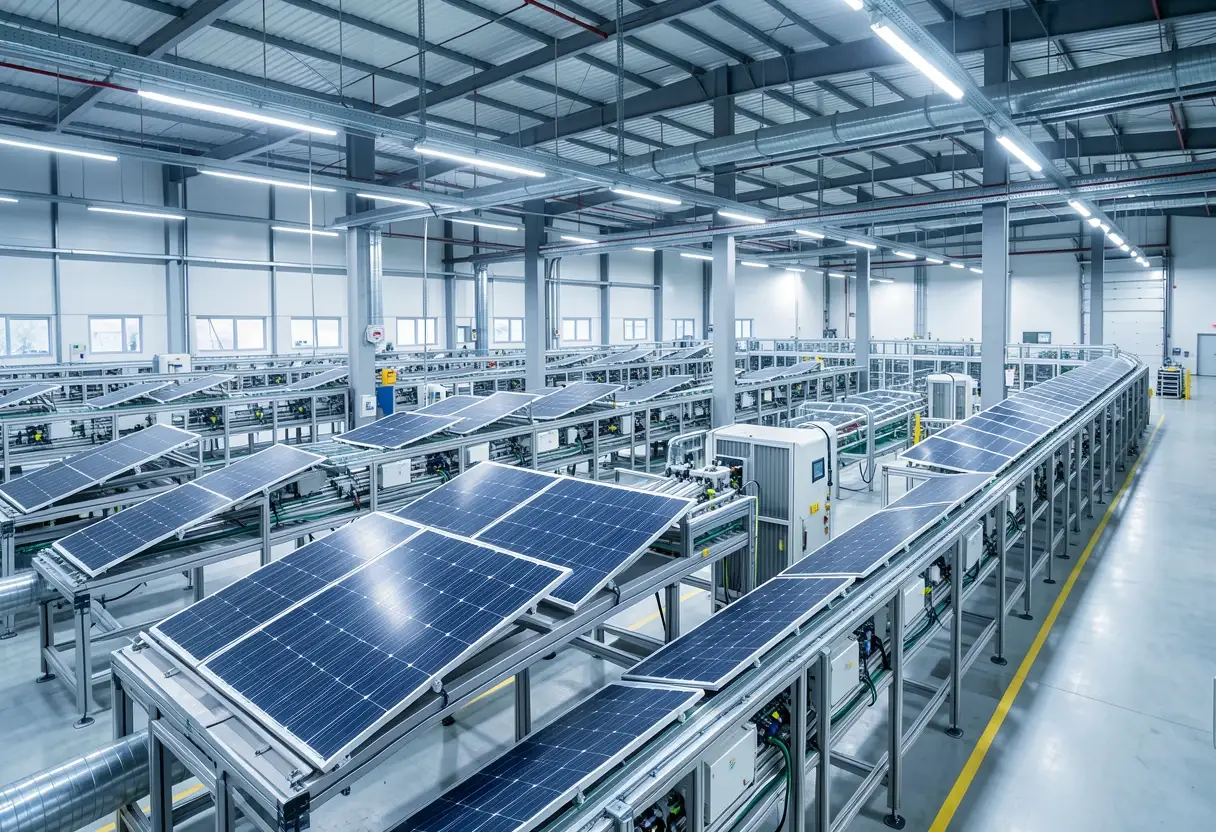
- Singulus's signed contract covers one turnkey HJT line worth over EUR 60 million (about $66 million), shipping in the first half of 2027 for SpaceX's Bastrop, Texas plant.
- Singulus stock rose 108.7% to EUR 26.50 on Wednesday, adding EUR 122.8 million of market value, then fell 17.4% to EUR 21.90 on Thursday.
- The United States installed 43.2 GW of solar in all of 2025; Musk's 100 GW a year is 2.3 times that figure.
- SpaceX has asked the FCC for permission to operate up to one million Starmind satellites, with first launches planned for the second half of 2027.
Elon Musk said Tuesday evening that SpaceX has ordered 100 GW a year of solar manufacturing equipment from Singulus Technologies, a 325-person machine maker in Kahl am Main, Germany, and that the equipment is "for Starmind to create a sentient sun." The post on X went up at 6:47 PM Eastern on November 10 and had drawn about 4.9 million views by Wednesday. The full text reads: "SpaceX has ordered 100 GW/year of HJT solar manufacturing equipment from Singulus in Germany. This is for Starmind to create a sentient sun." Starmind is SpaceX's planned fleet of solar-powered satellites built to run AI computing in orbit.
The order turns Starmind from a filing into a factory contract with a delivery date. It also ties one of the largest ambitions in commercial space to a company with 325 employees and EUR 48.3 million of annual revenue.
Singulus told its own version slightly earlier, in a release published after the German market closed. The company signed a supply contract with SpaceX for a turnkey production line that makes heterojunction (HJT) solar cells. The first line is worth more than EUR 60 million, about $66 million at this week's exchange rate. It ships in the first half of 2027 and supports satellite production at SpaceX's plant in Bastrop, Texas. Singulus said the partnership is meant to scale "to support more than 100 GW of production equipment." Singulus did not say per year. The per-year figure is Musk's.
Mike Nicolls, SpaceX's senior vice president for Starlink, said the deal "gives us a high-performance manufacturing path for solar cells for our Starmind satellites."
What does 100 GW a year actually mean?
The United States installed 43.2 GW of solar in all of 2025, according to the Solar Energy Industries Association and Wood Mackenzie, and had roughly 298 GW installed in total by the middle of this year. Their forecast calls for about 44 GW of new additions per year through 2030.
Musk's 100 GW a year is 2.3 times what the entire country installed last year. It equals about a third of every solar panel the United States has ever put up, produced each year, so three years of output would match the whole American fleet.
The number fits what SpaceX told investors before its June listing. The filing describes a long-term goal of putting up to 100 GW of power into orbit each year, which the company itself said would take thousands of launches a year. The published satellite design carries a computer drawing up to 250 kW at peak, so 100 GW of cells a year supports roughly 400,000 such satellites annually before losses. SpaceX has asked the Federal Communications Commission for permission to operate up to one million Starmind satellites. First launches are planned for the second half of 2027.
On Wednesday Musk explained why he counts orbital solar differently. "100GW in space is roughly equal to 800GW on Earth," he wrote, because ground solar "must be paired with massive batteries to continue powering compute at night."
The limit is simple: one EUR 60 million line is all Singulus has signed for. Read plainly, the order is SpaceX betting it can make solar cells faster than any factory on Earth does today, and the 100 GW a year is Musk's number for where the partnership is headed.
Who is Singulus Technologies?
Singulus was founded in 1995 as a management buyout from Leybold and built its name pressing CDs and DVDs. It still lists optical disc lines among its products, next to coating equipment for solar cells, semiconductors and medical packaging. It had 325 employees at the end of September.
Its 2025 revenue was EUR 48.3 million, about $53 million, with a net loss of EUR 14.2 million and EUR 6.2 million of cash at year-end. The first SpaceX line alone equals 1.24 times that entire year of sales and 72% of the EUR 83 million the company forecasts for 2026.
SpaceX is also the company's lender. The partnership began in March, and Singulus says SpaceX provided "significant funding" in March and again in October, when Singulus took out a subordinated secured loan of about EUR 22.75 million to repay its former largest shareholder.
What did the stock do?
The stock did what tiny stocks do when Musk names them. Singulus closed Tuesday at EUR 12.70 on Xetra, before the release and the post. On Wednesday it opened at EUR 18.80, touched EUR 27.30 and closed at EUR 26.50, up 108.7% on 799,838 shares traded against 147,033 the day before. On Thursday afternoon in Frankfurt it fell 17.4% to EUR 21.90.
With 8,896,527 shares outstanding, the company was worth EUR 113.0 million on Tuesday night, EUR 235.8 million on Wednesday night and EUR 194.8 million at Thursday afternoon's price. Wednesday alone added EUR 122.8 million of market value, 2.0 times the size of the order that caused it. The shares closed at EUR 1.465 on January 2, so even after Thursday's drop they are up 14.9 times this year.
A stock that doubles in a day on one order tells you the market has already priced orders that have not been signed. It also tells you the next day can take a fifth of it back, which is what Thursday did.
What happened to a retiree who read the post?
Gary is 67, a retired aerospace engineer with $2.4 million, most of it in a rollover IRA, and a taste for solar videos on YouTube. He read Musk's post Tuesday night and put $25,000 into Singulus, 1.0% of his money, through a broker that trades German shares. At Wednesday's exchange rate of 1.1063 dollars to the euro, that is EUR 22,598.
The outcomes split by the hour he clicked:
- If Gary bought at Wednesday's open of EUR 18.80, he got 1,202 shares for EUR 22,597.60. At the close they were worth EUR 31,853.00, or $35,239, a gain of $10,239, 41.0% in one session. After Thursday's drop they were worth EUR 26,323.80, or $29,122, still a gain of $4,122, 16.5%.
- If he read the morning headlines first and bought near the afternoon high of EUR 27.30, he got 827 shares for EUR 22,577.10. At Thursday afternoon's EUR 21.90 they were worth EUR 18,111.30, or $20,036, a loss of $4,940, 19.8%, inside 24 hours.
- If he bought at Wednesday's close of EUR 26.50, the most common moment for readers who saw the "stock doubled" stories at dinner, he got 852 shares. Thursday left them at $20,642, a loss of $4,336, 17.4%.
Gary's three outcomes ran from a $10,239 gain to a $4,940 loss on the same $25,000. In an IRA the gain is untaxed until withdrawal and the loss earns no deduction, so the account cushions nothing on the way down.
What should a SpaceX holder take from it?
For SpaceX shareholders the order is small change. SpaceX raised $85.7 billion in its June listing, and the first Singulus line costs about $66 million. SpaceX traded at $143.78 Thursday morning, 6.5% above its $135 IPO price and 28.8% below its record close of $201.80 on June 16.
What the order signals is that Starmind has moved from a filing to a factory contract with a delivery date. That is all it says. Neither company has disclosed the first line's output or the efficiency of the cells.
The price of Singulus, meanwhile, is set by who is chasing it, and the chasers leave as fast as they came. If the Starmind story is one an investor wants to own, the source's arithmetic is blunt: size it so a day like Thursday does not matter. At 1.0% of a $2.4 million portfolio, a total loss costs 1.0%.
The next Musk post, and the first Starmind launches planned for the second half of 2027, will decide whether the 100 GW figure becomes manufacturing capacity or stays a target.
Source: 247wallst.com
More from Rebecca Stone
Show full bio
Correspondent covering companies, deals and strategy in artificial intelligence and machine learning at AI In Context.
577 articles
Related articles
- Dan Ives on Musk's $1 Trillion Texas Problem: Why Florida Won't Help
- Google's AI Chips Head to Orbit Aboard SpaceX Falcon 9
- Google's Suncatcher sends a fridge-sized AI satellite to orbit on October 1
- Google's First Suncatcher Orbital Data Center Test Launches October 1
- SpaceX Seeks Starbase Tax Break for $24 Billion Gas Plant and Supercomputer