Genesis AI raises $500 million for dexterous humanoid robots
Genesis AI raised $500 million to scale humanoid robots trained on data from 100 workers wearing sensor gloves. It has built 30 to 40 Enos; their dexterous hands last weeks.
Why it matters
- Genesis AI raised $500 million in a Series A led by Khosla Ventures, Premji Invest and Eclipse.
- The round follows a $105 million seed announced in July 2025; Xian and Théophile Gervet founded the company in 2024.
- More than 100 workers wear Genesis sensor gloves and headset cameras that feed the company's training dataset.
- Genesis has built 30 to 40 Eno humanoids; a U.S. mass-manufacturing contractor begins work next year.
- Genesis's dexterous hands last only a few weeks of regular work before requiring replacement.
Genesis AI raised $500 million in a Series A funding round led by Khosla Ventures, Premji Invest and Eclipse, the robotics startup announced during a TechCrunch visit to its Silicon Valley facility.
CEO and co-founder Zhou Xian says the company has "cracked dexterous manipulation," the robot's ability to manipulate objects with its hands. That claim now anchors a $500 million bet.
The capital targets a gap TechCrunch identifies across the humanoid physical AI ecosystem: the distance between a laboratory demonstration and reliable automation. Closing it, the outlet says, is how the sector avoids another robot winter.
How much did Genesis AI raise, and who backed it?
The Series A is the startup's second disclosed round. Genesis announced a $105 million seed round in July 2025.
Xian and Genesis president Théophile Gervet met as graduate students in a Carnegie Mellon University lab and co-founded the company in 2024.
The money funds a vertically integrated business, meaning control of data, software and hardware under one roof: Genesis generates most of its own training data, develops its own generative AI model, and coordinates both with the design and construction of its humanoid robot.
What did the robot actually do?
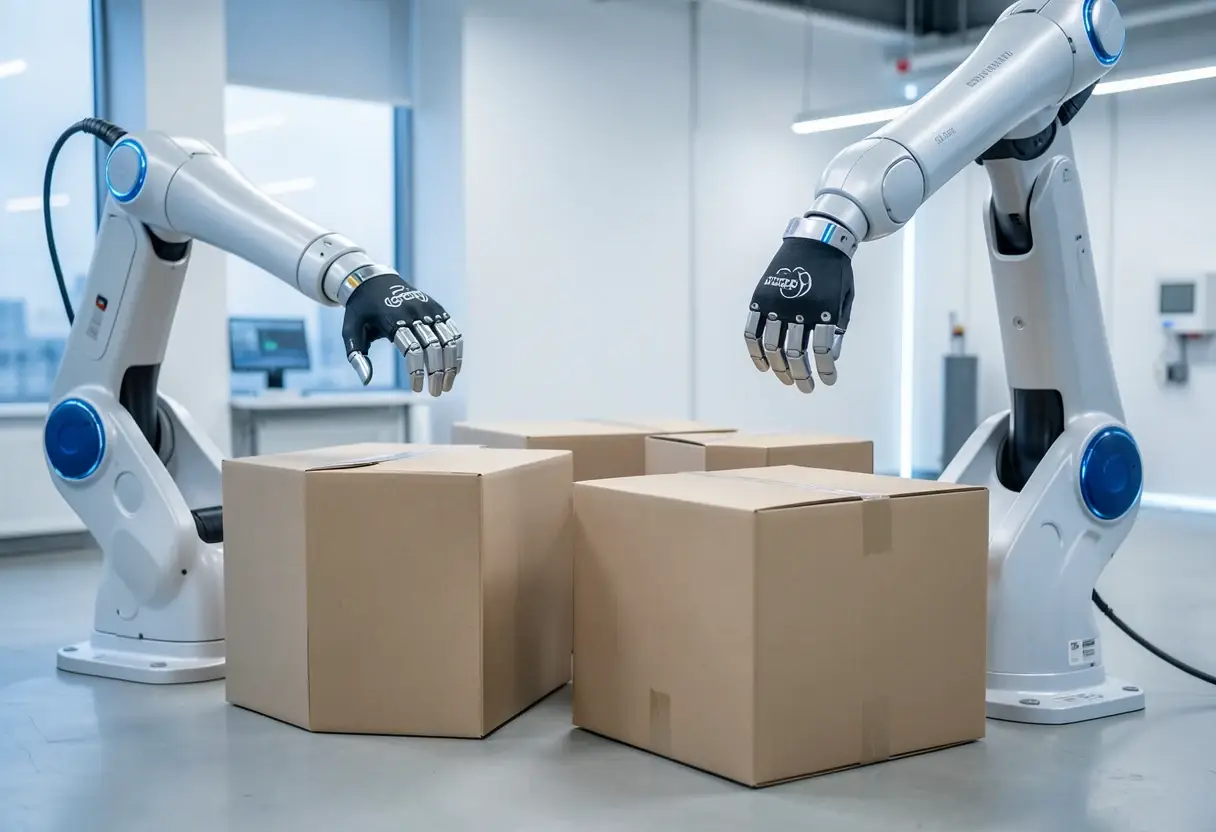
At the Silicon Valley facility, Genesis ran its physical AI model on a pair of off-the-shelf robotic arms. The sequence combined perception, manipulation and packaging in one unbroken task.
- Picked up two small cardboard boxes.
- Scanned both boxes.
- Placed them inside a larger cardboard box.
- Folded the larger box closed.
- Taped the box shut.
- Plucked a label from a strip of printer tape and applied it to the box.
TechCrunch called the demonstration impressive and exactly the kind of complex workflow robots still struggle to complete.
Genesis would not let the reporter rearrange the robot's setup to test it, but the company agreed to re-run the presentation.
On the second attempt, the robot fumbled a box and struggled to peel the tiny adhesive label from the printer tape. A Genesis executive called such failures "hiccup data," material that can improve the model.
The framing treats failure as training material rather than a reason to delay deployment. Reliability across repeated runs, not one successful take, separates a laboratory result from deployable hardware.
Xian said the model was more capable while operating Eno, the company's flagship humanoid robot. Eno was not ready to demonstrate its abilities for TechCrunch.
Why do the sensor gloves matter?
Genesis separates itself from competitors including Figure and Agility through two choices: dexterity, and control of the data that teaches it.
More than 100 real workers around the world wear Genesis sensor-enabled gloves and accompanying headset cameras while they work. Their activities feed a training dataset that trains the company's model.
The gloves capture force data, which Genesis treats as the apparent unlock for effective manipulation. The robots wear the same sensor-equipped gloves, and their hands are built to mimic the proportions of human hands.
Xian says that fidelity enables the robots' capabilities in sorting and wire manipulation. Owning the gloves also lets Genesis generate most of its training data without depending on outside datasets.
What does simulation add?
Adviser Minchen Li co-authored an influential physics algorithm that Genesis uses to create millions of high-fidelity models of the robot's experience.
The company pairs those simulated models with real human demonstrations and its own generative model.
"We wanted to ship the best robot, end-to-end product," Xian said.
Can Eno scale beyond 30 units?
Genesis has built 30 to 40 Enos. The company would not disclose how many it plans to produce in the year ahead.
Genesis chose a mass-manufacturing contractor to begin work next year in the United States, and it has finalized the design of the mass-produced version.
Eno is also in a pilot with a handful of undisclosed customers. Genesis named neither the customers nor a production target for the year ahead.
The machine carries the styling influence of the late Steve Jobs, presenting as an iMac on wheels rather than a Terminator-style metal skeleton. Genesis said Eno reflects "the feeling" the company wants to deliver to customers.
Where is the real bottleneck?
Xian named hardware, not software, as the binding constraint on scale: mechanical design on one side, and the supply chains needed to produce industrial-grade machines on the other.
The clearest measure of that constraint is durability. Genesis's dexterous hands last only a few weeks of regular work before they need replacement.
That sets a replacement cycle for any Eno deployment. It also concentrates risk in hardware, where better models cannot compensate for parts that fail within weeks.
A model that improves quickly does not help if the hands attached to it expire before the next shift.
Does the model architecture matter?
Xian rejected the finer distinctions between Vision-Language-Action models, which link vision and language to motor output, and World-Action models, which predict actions from a representation of the world.
His view: the software is ultimately transformers and attention, the mechanisms behind modern generative models. Infrastructure and data quality decide the rest.
"what really matters is is the whole infra — the training infrastructure, the data infrastructure, and the quality of the data," Xian said.
He put a number on the rest. Xian estimates that "the model architecture contributes to maybe 10% of of the final [result]."
He also dismissed the case for another scientific leap. "I don't think we expect or we need another fundamental scientific leap," he told TechCrunch. "No, we have all the recipes. It's just about execution."
What has to happen next?
The next phase rests on three measurable steps: mass-produced Enos built at a U.S. contractor starting next year, hands built to outlast their current few-week service life, and a flagship demonstration Eno was not ready to give.
The Series A follows the $105 million seed from July 2025, with the company founded in 2024 by Xian and Gervet after their Carnegie Mellon days.
Until the hands last beyond the weeks Xian described, and until Eno repeats the box-and-label workflow without fumbling it, the round expands a company whose flagship robot could not perform for TechCrunch.
The contractor's first U.S. production run, beginning next year, is the next test.
Source: techcrunch.com
More from Marcus Bennett
Show full bio
Senior reporter covering companies, deals and strategy in artificial intelligence and machine learning at AI In Context.
718 articles
Related articles
- Genesis AI Raises $500M to Put General-Purpose Robots to Work
- Unsiloed AI Raises $7.5M Seed to Turn Enterprise Documents Into AI-Ready Data
- Pluto Security Exits Stealth With $42M to Watch What AI Agents Do
- Mirendil Raises $1B Series A to Scale One-Researcher AI Development
- Mirendil Raises $1 Billion Series A on a One-Researcher Model Bet