Dell lifts AI-server outlook to $78 billion amid $132.3B backlog
Dell lifted fiscal 2027 AI-server revenue guidance to $78 billion and ended fiscal Q3 with a $132.3 billion backlog, but component supply remains the constraint.
Why it matters
- On November 24, 2026, Dell raised fiscal 2027 AI-optimized server revenue guidance to $78 billion from $74 billion.
- The quarter ended October 30, 2026 produced $54.9 billion in revenue, up 103% year over year.
- AI-server backlog reached a record $132.3 billion after Dell booked $60.2 billion in orders.
- AI-optimized server revenue reached $22.0 billion; ISG generated $7.1 billion in operating income at a 17.0% margin, up from 12.4%.
- Dell raised total revenue guidance to $202.0 billion from $192.0 billion and expects approximately $23.5 billion in AI-server revenue for the fourth quarter.
Dell Technologies raised its fiscal 2027 AI-optimized server revenue outlook to $78 billion on November 24, 2026, after reporting third-quarter revenue of $54.9 billion, up 103% year over year.
The company ended the quarter on October 30, 2026, with a record $132.3 billion AI-server backlog, representing orders not yet converted into revenue, after booking $60.2 billion in orders.
Dell’s own guidance shifts attention from demand to delivery. The $132.3 billion backlog provides booked work, but the $78 billion fiscal 2027 target depends on converting those orders into installed, revenue-generating systems at management’s guided pace.
What drove Dell’s infrastructure profit growth?
Dell reported $22.0 billion in revenue from AI-optimized servers during the quarter ended October 30, 2026. The figure accounted for a substantial portion of the company’s $54.9 billion in total quarterly revenue.
Dell’s broader Infrastructure Solutions Group (ISG), which includes traditional servers, networking and storage, generated $7.1 billion in operating income. Its 17.0% operating margin, meaning operating income as a share of revenue, rose from 12.4% a year earlier.
Dell management attributed the margin expansion primarily to scale, operating-expense efficiencies and demand for storage based on Dell’s own intellectual property. The company identified procurement scale and cost control as central contributors.
Traditional-server demand drew support from enterprises refreshing aging systems, modernizing data centers and adding CPU-based compute for AI inference, or using trained models to generate outputs. Dell said those trends support infrastructure profit beyond AI systems themselves.
The combination gives Dell two distinct revenue engines: AI-optimized systems for large-scale model workloads and traditional infrastructure for enterprise refresh cycles. ISG’s broader mix also exposes Dell to storage, networking and general-purpose server demand.
How broad is demand beyond large cloud buyers?
In prepared remarks, Dell said its “AI Factory customer base had passed 7,500” across neocloud providers, sovereign customers and enterprises. The figure measures a broad installed customer base rather than a single category of large cloud buyers.
Dell described its opportunity pipeline, or potential demand beyond booked orders, as remaining a multiple of its $132.3 billion backlog. The company did not provide a single dollar figure for that pipeline.
Enterprises were the fastest-growing component of the pipeline’s sequential expansion. Dell said that pattern indicates demand is broadening beyond large cloud buyers, an important signal for a supplier whose largest deployments can involve complex financing and substantial physical infrastructure.
Dell’s disclosure separates two measures that can otherwise be conflated. Backlog represents booked orders awaiting conversion, while the opportunity pipeline represents prospective business. The first carries an explicit revenue target; the second remains a multiple without a stated value.
Why does Dell screen every AI order twice?
Dell reviews every AI order before the associated systems enter production. Its review covers three areas:
- The customer’s financial capacity and the underlying end-user contracts.
- Trade and export compliance.
- Access to capital, land and power needed for the deployment.
Dell runs those checks when it agrees to a purchase order and again before production begins. The second review can therefore change how an accepted order proceeds after it has entered the backlog.
The screening process ties backlog quality to customer financing and the practical resources required to operate AI infrastructure. An order supported by viable end-user contracts and available power carries a different execution profile from one that lacks those foundations.
Export compliance gives the review a direct policy function. Dell evaluates trade restrictions before accepting the order and again before manufacturing, reducing the risk that its production schedule advances despite a regulatory obstacle.
How much faster can Dell deploy an AI rack?
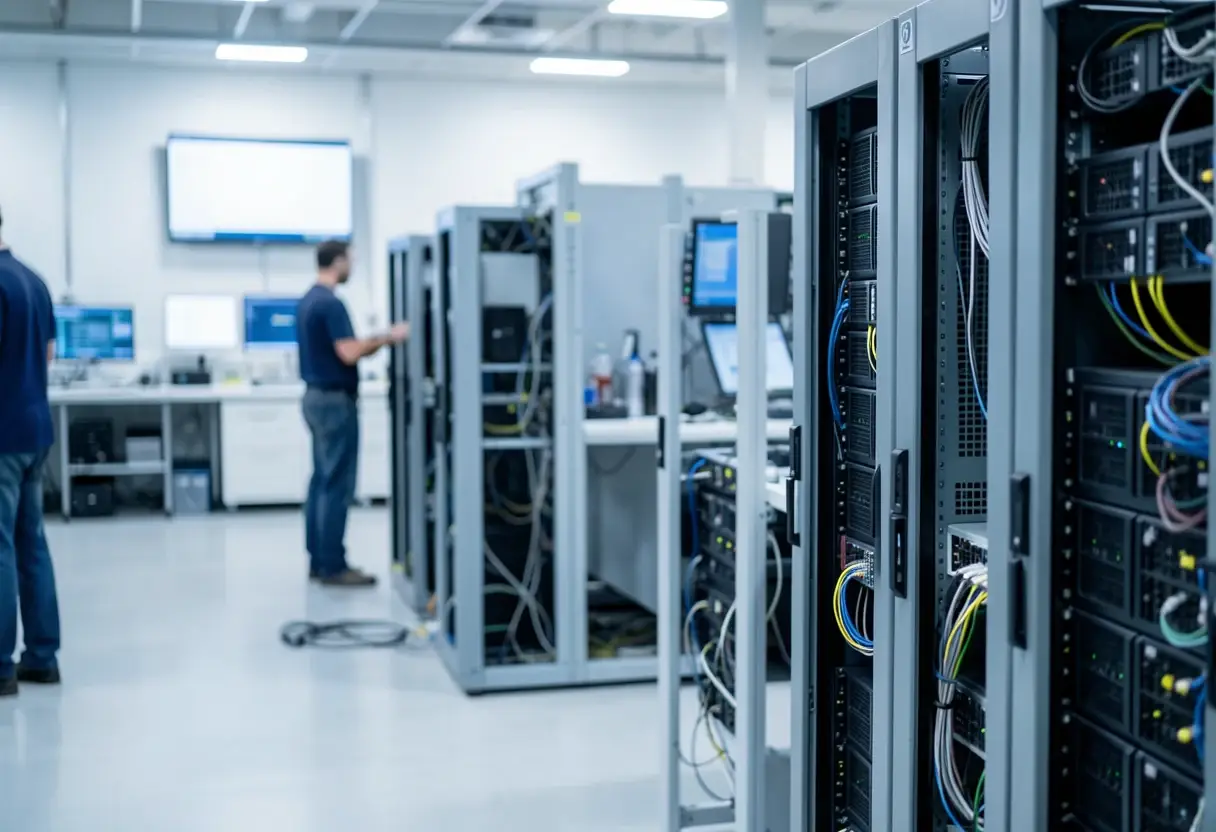
Before shipment, Dell runs full-rack tests that include power-up, thermal-compliance checks and network validation. The process tests the assembled system rather than individual components in isolation.
Dell says teams can stand up a rack within six hours of delivery. That installation target reduces the time between hardware arrival and a functioning deployment, particularly for customers managing data-center space, cooling and network schedules.
On large deployments, Dell says its process can deliver a four-to-six-week advantage in time to first token over competitors. Time to first token means the moment a deployed model generates its first output.
Dell links that deployment advantage directly to backlog conversion. Faster installations allow the company to recognize revenue sooner after a customer accepts delivery, reducing the gap between an order’s placement and its financial realization.
Execution now matters more.
What changed in Dell’s fiscal guidance?
Dell now guides to:
- $78 billion in fiscal 2027 AI-optimized server revenue, replacing the previous $74 billion target.
- $202.0 billion in full-year total revenue, raised from $192.0 billion.
- Approximately $23.5 billion in AI-server revenue for the fourth quarter.
The AI-server target represents the clearest change to the prior forecast. Dell moved it from $74 billion to $78 billion on November 24, 2026, while also lifting its broader revenue guidance.
The fourth-quarter AI-server forecast of approximately $23.5 billion stands close to the $22.0 billion generated during the quarter ended October 30. Dell expects the company to sustain a high quarterly revenue level as it works through the record backlog.
Taken together, the figures require sustained revenue conversion through the rest of fiscal 2027. Dell has raised its own targets, but its $132.3 billion backlog still depends on component procurement, factory output and customer installation schedules.
Can Dell convert a $132.3 billion backlog?
Dell management said infrastructure demand “continues to outpace supply.” The statement places the company’s order growth against a production limit rather than a shortage of customer interest.
Dell expects the gap between component supply and end-user demand to widen in fiscal 2028. That forecast increases pressure on procurement and manufacturing even as Dell expands the infrastructure needed to assemble complete AI systems.
The company’s order-vetting and rack-level integration processes address two separate risks. Screening addresses the quality and regulatory eligibility of customer orders, while factory testing and six-hour installation address the speed of putting accepted systems into service.
Neither process resolves the upstream component constraint identified by Dell. Procurement and manufacturing now stand as the open execution questions behind the higher revenue outlook.
Dell’s next quarterly results will test whether procurement and factory throughput can turn the $132.3 billion order book into deployed systems before the expected fiscal 2028 supply gap becomes more severe. For customers, faster rack setup offers immediate deployment gains; for Dell’s forecast, component availability remains decisive.
Source: unite.ai
More from Marcus Bennett
Show full bio
Senior reporter covering companies, deals and strategy in artificial intelligence and machine learning at AI In Context.
903 articles