Deere buys Orchard AI to turn crop scans into field instructions
John Deere’s November 19, 2026 acquisition of Orchard AI could link per-tree crop maps to spraying, harvest planning and other specialty-crop fieldwork through farm equipment.
Why it matters
- John Deere announced on November 19, 2026, that it had acquired Orchard Robotics.
- Orchard AI was founded in San Francisco in 2022.
- FruitScope Vision cameras operate at 1 to 12 mph and return scan results the next morning.
- Orchard AI says its hardware supports operations from 100 acres to more than 10,000 acres.
- The per-acre, per-year subscription includes hardware, unlimited scans, FruitScope OS, Canary AI, training and support.
By Elena Vasquez
John Deere announced on November 19, 2026, that it had acquired Orchard Robotics, a San Francisco company founded in 2022 that operates as Orchard AI. The acquisition adds vehicle-mounted cameras and software intended to turn tree-by-tree crop measurements into recommendations that guide fieldwork for specialty-crop growers.
Deere says the aim matters because a missed spray application or mistimed harvest can affect fruit quality, yield and a season’s profitability. For Deere, the strategic value is making plant-level intelligence an input to fieldwork rather than another standalone dashboard.
Deere’s announcement frames the combination in layers. Orchard AI would contribute the plant-level measurement and recommendation layer. Deere would provide the machinery and field interfaces through its precision-agriculture portfolio. The proposed link would connect those layers during the growing season, rather than leave the final step in a separate dashboard.
What does Deere gain from Orchard AI?
Orchard AI develops crop-intelligence products for growers of high-value specialty crops, according to the company. The acquisition brings its plant-level data capability into Deere’s precision-agriculture portfolio.
Tim Marquis, Deere’s director of farm systems innovation, described the objective as connecting crop intelligence with equipment that can execute fieldwork precisely throughout the growing season. That objective links crop intelligence with the vehicles growers already use, according to Orchard AI’s product documentation.
The proposed link would move Orchard AI’s measurements out of a separate dashboard. A grower could receive a recommendation for a specific block and deliver it to equipment in the field.
The announcement presents that connection as a possibility, not as a commitment to specific product availability. The integration challenge is converting Orchard AI maps into routine equipment workflows without losing grower trust.
How does Orchard AI measure a crop?
Orchard AI says its cameras travel through orchards and vineyards on farm vehicles, collecting data on individual trees, vines and plants during repeated passes throughout the season. According to Deere, the system analyzes hundreds of images per tree on each pass. It produces yield estimates, fruit counts, fruit size and color data, and canopy measurements.
Orchard AI says FruitScope software makes those measurements available for farm-management decisions.
Orchard AI’s product documentation says FruitScope Vision cameras can mount on tractors, all-terrain vehicles and other farm vehicles growers already use. They operate at 1 to 12 mph and return scan results the next morning.
Orchard AI says its hardware supports operations ranging from 100 acres to more than 10,000 acres.
Orchard AI says FruitScope OS provides per-tree maps covering fruit count, size, color, disease and canopy conditions. It also includes harvest-planning and crop-load-management tools on phones and computers.
The maps track the individual plant rather than only summarizing a field, according to Orchard AI’s product description. Repeated passes then add information as conditions change during the season.
What does the subscription include?
Orchard AI describes Canary AI as software that reasons over farm data to answer questions and recommend what to do next. Its listed crops include:
- Apples, wine and table grapes
- Blueberries and cherries
- Almonds, pistachios and citrus
The company offers a per-acre, per-year subscription covering camera hardware, unlimited scans, FruitScope OS, Canary AI, training and support for growers using the system. Growers do not have to purchase the camera hardware separately under that model.
As described in the acquisition announcement, the arrangement gives Deere a subscription software offering built around repeated crop scans, in addition to the sensing equipment itself.
Under Orchard AI’s stated model, hardware, software, AI recommendations, training and support sit inside one annual agreement. The structure also gives Deere a recurring subscription attached to repeated crop scans, alongside its sensing equipment.
This model also links a farm-data service to equipment growers may already own. Orchard AI’s documentation says the cameras work with tractors, all-terrain vehicles and other farm vehicles already in use. Deere still has to integrate that convenience with its own equipment workflows.
How could crop maps reach the field?
Deere framed the technology around the cost of poor timing. Weather, labor constraints and changing crop conditions narrow decision windows for specialty-crop work.
The announcement identifies four workflows for the combined technology:
- Pruning
- Thinning
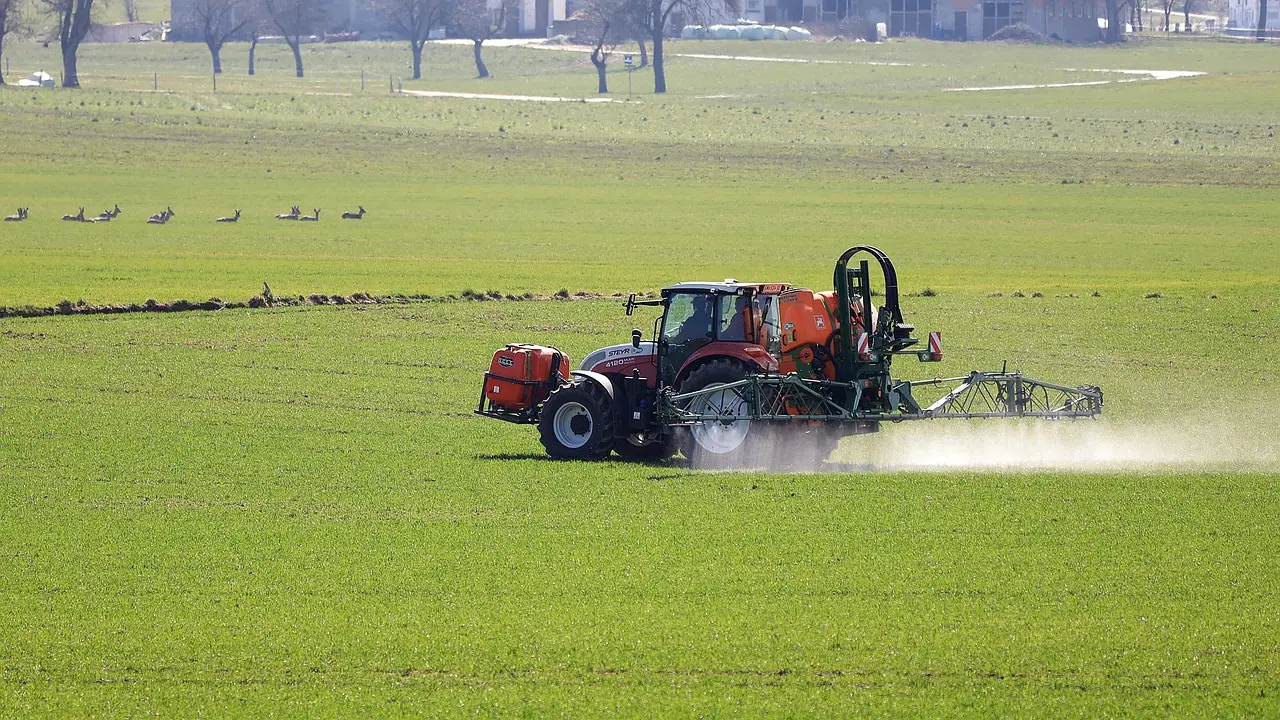
- Applying crop treatments where needed
- Determining which blocks are ready for harvest
One proposed workflow starts with higher bloom counts. Those counts generate a prescription for where to spray. The recommendation could go to a mobile device for in-field application or to an in-cab G5 display.
Deere presented these examples as possibilities, not as a commitment to specific product availability. The proposed connection would turn crop data into instructions for work in specific blocks, according to the company.
That workflow addresses a practical problem in orchards and vineyards. A recommendation may be precise at the tree or block level, while fieldwork still has to account for weather, labor and changing conditions.
Deere’s pitch is to carry that context into the machinery used during the season. The announced route centers on delivering recommendations to mobile devices and in-cab displays during fieldwork.
For a grower, the practical distinction is between seeing a condition and receiving a location-specific instruction. Orchard AI supplies the first through its per-tree maps. The proposed Deere connection would supply the second through mobile and in-cab interfaces.
What must Deere preserve as it scales Orchard AI?
Tyler Klick of Redwood Empire Vineyard Management, an early user of Orchard AI’s technology, said the scans provided useful precision-farming insights into vineyard conditions. He also said CEO Charlie Wu’s team had listened to customer needs and put them into action. Klick’s comments place Orchard AI’s early customer work inside the much larger equipment company Deere has acquired.
Justin Rose, president of Deere’s Worldwide Agriculture & Turf Division for Small Ag & Turf, said the company wants to use its scale to help Orchard AI reach more growers.
“A big part of what makes Orchard AI successful is its speed of innovation and the close relationships it has built directly with customers,” he said. Rose said Deere wants to preserve those strengths as the company expands the product’s reach.
Rose’s remarks make customer relationships part of the acquisition rationale, not a side issue. The announcement says Deere will use its scale while preserving Orchard AI’s speed and direct customer ties.
The acquisition leaves a central integration question. Orchard AI must translate per-tree maps into repeatable equipment instructions while keeping the close customer feedback loop that Tyler Klick described.
The next test comes in routine field operations: whether growers will use those recommendations rather than treating them as another analytical dashboard. The payoff will come from turning repeated crop scans into specific directions for pruning, thinning, treatment and harvest.
Source: unite.ai
More from Elena Vasquez
Show full bio
Market editor covering technology and product news in artificial intelligence and machine learning at AI In Context.
795 articles
Related articles
- Anthropic's $97 IPO Close Fails to Stop Asia's Worst Week Since 2020
- SK hynix to convert Kioxia bonds into 14.1% indirect stake
- Nvidia Finances $118 Billion of Its Own AI Demand, Fed Flags Risk
- SK Telecom's $200 Million Anthropic Bet Is Now Worth $3.75 Billion
- IonQ Jumps 9% as Anthropic's IPO Lifts Beaten-Down Quantum Stocks