DeepMind's AlphaGenome Atlas Maps All 9 Billion Human DNA Variants
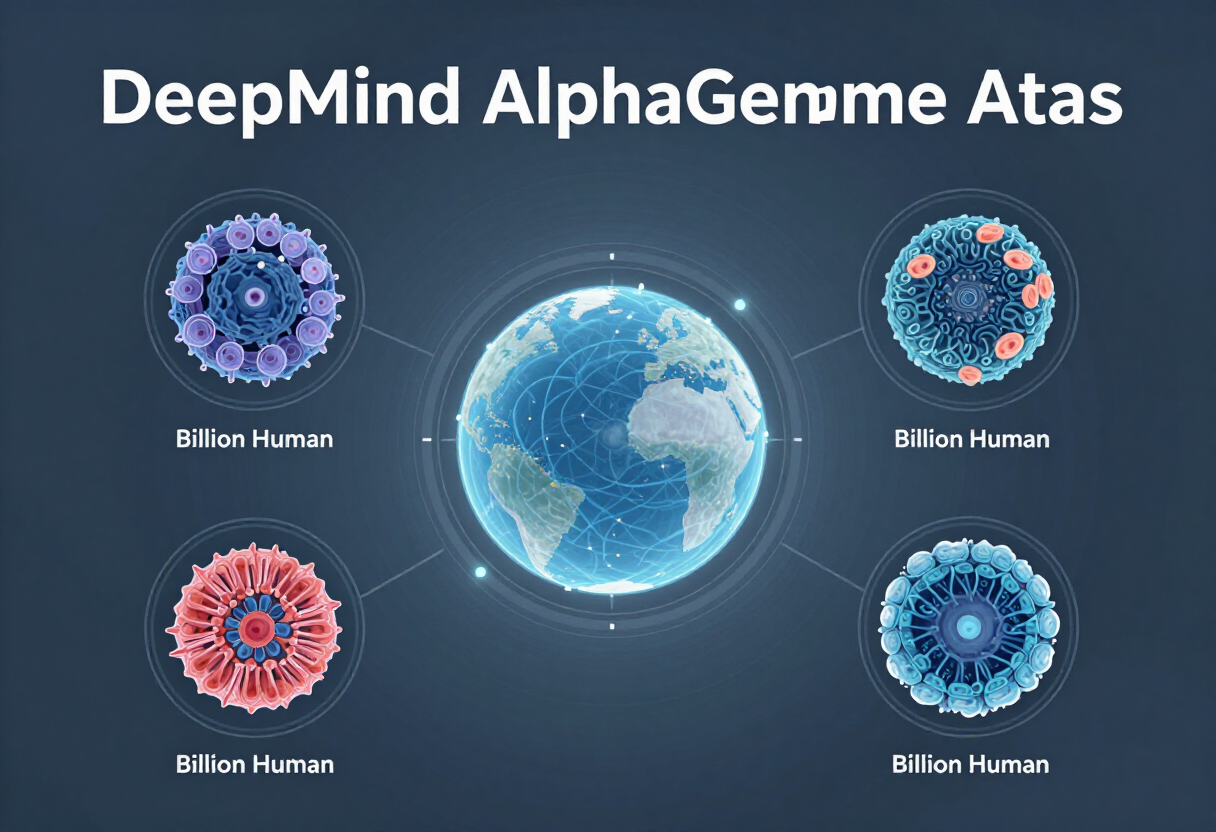
DeepMind's AlphaGenome Atlas precomputes the effects of all 9 billion possible single-letter DNA variants in a 1-petabyte dataset, free for academic use, with early rare-disease discoveries already lab-validated.
Updated
Why it matters
- AlphaGenome Atlas contains predictions for all 9 billion possible single-nucleotide variants in the human genome in a 1-petabyte dataset, over 30 times larger than the AlphaFold Database.
- The new AVI score combines AlphaGenome and AlphaMissense predictions into a single number covering both coding and non-coding regions, with best-in-class performance on variant pathogenicity benchmarks.
- Collaborators using Atlas identified a DNM1 splice variant linked to epileptic encephalopathy and uncovered 22% more non-coding genetic associations in whole-genome data from over 54,000 UK Biobank participants.
Google DeepMind has released AlphaGenome Atlas, a platform containing predictions for the effects of all 9 billion single-nucleotide variants — every possible single-letter DNA change in the human genome. The company calls it the most comprehensive catalogue of how genetic mutations affect molecular biology, and it is available today for academic research through a free website portal.
The scale is unusual even by genomics standards. AlphaGenome Atlas is a 1-petabyte dataset, more than 30 times larger than the AlphaFold Database. When DeepMind expanded that database in 2022, it grew available 3D structure information from roughly 190,000 experimental structures to more than 200 million predictions, covering nearly all catalogued proteins known to science. The AlphaFold Database became a fixture of life-science research largely because it required no coding experience. DeepMind says it built Atlas with the same goal: making a vast dataset explorable through intuitive visualizations.
The release matters because variant interpretation remains the bottleneck of genetic medicine. There are roughly 9 billion possible single-letter mutations in the human genome, and testing each one in the lab is practically impossible, according to DeepMind. Researchers hunting the cause of a rare disease typically face thousands of candidate variants, most of them harmless.
Precomputing an AI model at genome scale
Atlas builds on AlphaGenome, the AI model DeepMind released earlier that predicts how genetic variants affect biological processes. AlphaGenome has seen widespread research use for analyzing individual variants. With Atlas, DeepMind precomputed the model's predictions across the entire genome, so researchers no longer need to run each query themselves.
The platform contains thousands of molecular effect predictions per variant, spanning multiple aspects of gene regulation across hundreds of human and mouse cell types and tissues. Just as an atlas links together features of the land like altitude and location, AlphaGenome Atlas charts the molecular effects of DNA variants across the genome, DeepMind writes.
Alongside the predictions, DeepMind is releasing the AlphaGenome Variant Impact (AVI) score: a single number per variant that combines the strengths of AlphaGenome and AlphaMissense, the company's model for predicting the impact of protein-altering variants. The score covers both coding regions — the 2% of the genome that codes for proteins — and non-coding regions, the remaining 98% that orchestrates gene activity and houses most trait-associated variants. DeepMind's testing shows the AVI score delivers best-in-class performance across many variant pathogenicity and rare disease benchmarks.
Each AVI score also ships with feature attributions that flag which molecular processes — such as RNA splicing or gene expression — a variant is predicted to disrupt most. And the Atlas includes a collection of more than 2,500 recurrent DNA sequence motifs, the "words" of the genome, mapped to their locations, letting researchers link variants directly to the functional sequences they disrupt.
Rare disease discoveries already validated in the lab
External collaborators have already used the resource to produce experimentally verified findings. Working with the GREGoR Consortium, Laura Covill and Anne O'Donnell-Luria of the Broad Institute and their colleagues applied the AVI score to prioritize variants that previous research on an unsolved rare disease had overlooked. The team discovered a variant affecting DNM1, a gene strongly linked to epileptic encephalopathy.
The underlying AlphaGenome predictions showed exactly how the variant worked: it created an incorrect splice site — a mistake in the cell's genetic instructions — leading to an abnormal extension of the resulting protein. Experimental screens validated the prediction and found nearby variants with similar effects.
Finding non-coding signals in population-scale data
Atlas has also produced results in population genetics. Gareth Hawkes, a Medical Research Council fellow at the University of Exeter, applied AlphaGenome Atlas to whole-genome data from more than 54,000 UK Biobank participants. Identifying rare non-coding variants associated with a trait is notoriously difficult because harmless genetic changes create statistical background noise. By grouping rare variants according to their predicted molecular effects, Hawkes uncovered 22% more non-coding genetic associations that would otherwise have been undetectable.
That approach let him pinpoint specific regulatory variants driving the abundance of circulating proteins, including PLA2G7, linked to aging, and EGLN1, a vital cellular oxygen sensor. Hawkes then used Atlas to examine how hundreds of millions of non-coding variants in the UK Biobank might relate to body mass index. Focusing on the 1% of non-coding variants Atlas predicts to be most impactful, he identified 19 genetic regions that could direct the next stage of targeted research into the trait.
At the Stowers Institute for Medical Research, Julia Zeitlinger and Melanie Weilert used the motif resource to categorize which transcription factors only affect DNA accessibility versus which ones can also turn genes on and off — a distinction that helps interpret non-coding variants.
Availability and what comes next
AlphaGenome Atlas is available through a website portal, the AlphaGenome API, and as a skill in Google Antigravity. Access is free for non-commercial use from today, with commercial use on Google Cloud coming soon. The AlphaGenome base model is already available for academic use on GitHub and via the API, and for commercial use on Cloud via Model Garden.
DeepMind frames the release as a baseline rather than an endpoint. As models like AlphaGenome improve, the company says its maps of the entire human genome will become increasingly comprehensive and precise, and Atlas resources can be integrated into broader agentic systems to support end-to-end scientific workflows — finding therapeutic targets, understanding genetic disorders, and directing targeted experimental validation. The company notes that AlphaGenome has not been validated for or approved for any clinical use.
Acknowledged collaborators include the University of Exeter, Broad Institute, Boston Children's Hospital, Stowers Institute for Medical Research, Harvard University, Memorial Sloan Kettering Cancer Center, the Center for Genomic Medicine at Massachusetts General Hospital, and the University of Kansas Medical Center.
Original: docs.cloud.google.com
More from Elena Vasquez
Show full bio
Market editor covering media and advertising at AI In Context.
122 articles
Related articles
- AlphaFold at Five: 3 Million Researchers, a Nobel, and a New Playbook for AI-Driven Science
- Google Publishes Co-Scientist in Nature, Opens AI Hypothesis Tool to Researchers
- OpenAI's o3 Helps Diagnose 18 Rare Disease Cases That Stumped Specialists
- Google DeepMind Joins DOE's Genesis Mission to Bring AI to 17 National Labs
- Google DeepMind Puts $10M Toward Multi-Agent AI Safety