AI and Chip Stocks Rebound as Nasdaq-100 Futures Jump Over 3%
Nasdaq-100 futures jumped over 3% Monday as Nvidia rose 9% premarket after losing $1.04 trillion in market value. Traders now price a 96% chance of a December rate hike.
Why it matters
- Nasdaq-100 futures jumped more than 3% Monday; S&P 500 futures gained 2.5%.
- Nvidia lost roughly $1.04 trillion in market value between Nov. 11 and Nov. 20, falling from $4.19 trillion to $3.14 trillion.
- Nvidia reported $115.8 billion in Q3 revenue on Nov. 17, up 103% year over year.
- Anthropic raised roughly $81.3 billion at $83 per share in its Nasdaq IPO under ticker 'ANT'.
- Traders price about a 96% probability of a 25-basis-point Fed rate hike in December, per CME FedWatch.
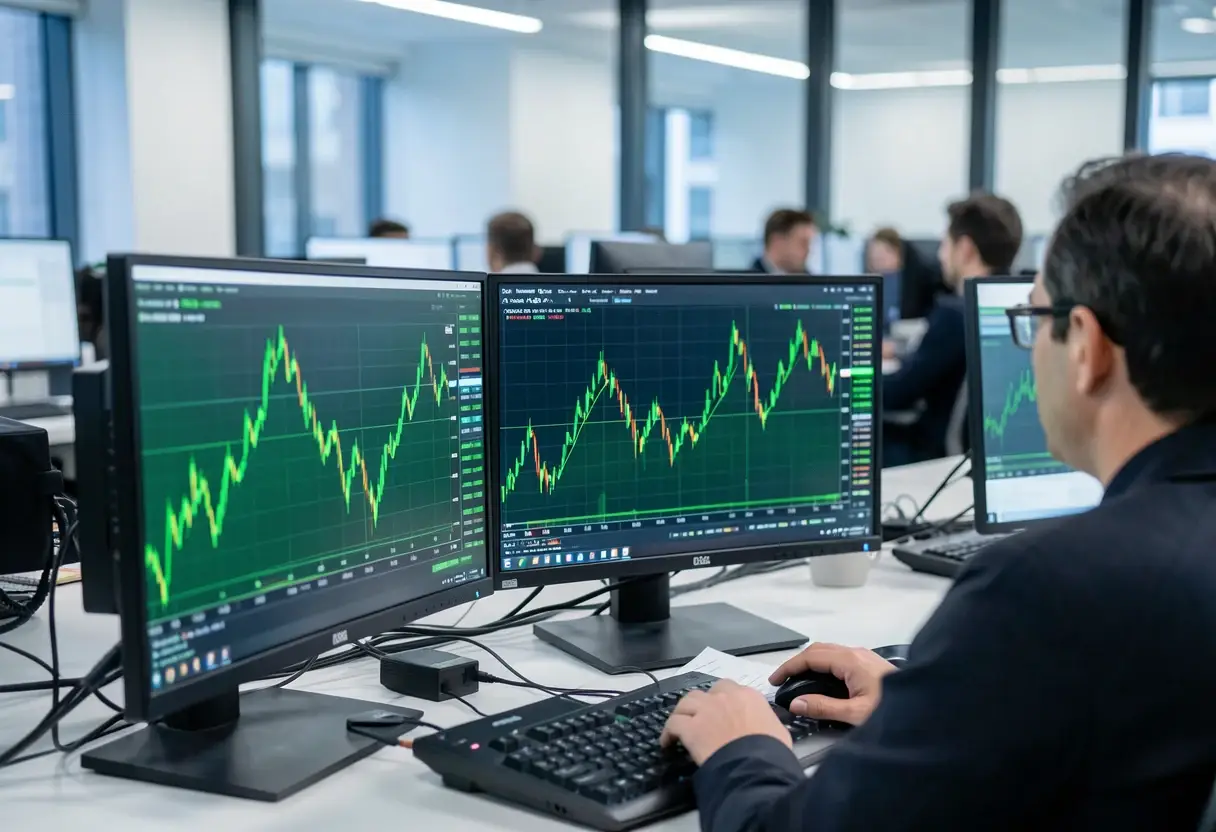
U.S. stock index futures climbed early Monday as investors moved back into artificial intelligence and data center stocks, one session after a brutal sell-off dragged every major benchmark into correction territory. Nasdaq-100 futures jumped more than 3%, S&P 500 futures gained 2.5%, and Dow Jones Industrial Average futures rose just under 2%.
The bounce matters beyond the tape. Last week's rout was concentrated in the exact names that carried the market's gains for two years — Nvidia, the neocloud operators, the data center builders — and Monday's premarket move is the first real test of whether investors see that sell-off as overdone or as the start of something worse.
How bad was last week, in numbers?
The S&P 500 closed Friday at 6,910.39, down 8.6% for the week and more than 10% below its recent record high — the textbook definition of a correction. The Dow finished at 48,147.33, down 1.93% on the day after falling roughly 8% on the week. The Nasdaq Composite closed at 22,617.73 following a weekly drop of about 10%, its worst performance since March 2020.
The Nasdaq-100 sat in worse shape: roughly 18% below its 52-week high, hovering near bear-market territory before Monday's futures rally.
Takeaway: this was the sharpest tech-led drawdown since the pandemic crash, and Monday's open is the market's first chance to price that in with cooler heads.
Which stocks are leading the rebound?
Semiconductors paced the early gains. Nvidia rose more than 9% in premarket trading — the single biggest driver of the futures move, given its index weight. Advanced Micro Devices gained 5.8%, Broadcom added 5.7%, and Micron Technology climbed about 6%.
The AI-adjacent neocloud and data center operators, which bore the brunt of last week's pullback, rallied even harder before the bell:
- CoreWeave: up 10.1%
- Nebius: up nearly 10%
- IREN: up 10.2%
- Applied Digital: up about 10%
These are the companies that lease AI compute at scale, and they had sold off hardest on fears that the AI buildout was repricing. A near-uniform 10% bounce across the group suggests investors are treating last week's lows as a buying opportunity rather than a breakpoint.
Takeaway: the rebound is broad across the AI supply chain, not limited to one bellwether.
What triggered the sell-off in the first place?
The rout accelerated after Nvidia's co-founder and CEO, Jensen Huang, resigned immediately as president, CEO and board member. Chief Financial Officer Colette Kress stepped in as interim chief executive.
The numbers around that departure show how violently the market reacted. Between its November 11 close and its November 20 intraday low, Nvidia shed roughly $1.04 trillion in market value, falling from $4.19 trillion to $3.14 trillion. That collapse came even after the company reported $115.8 billion in third-quarter revenue on November 17 — up 103% from a year earlier.
A trillion-dollar loss on the back of a leadership shock, in a quarter where revenue doubled, is the clearest signal of how much of Nvidia's valuation rests on continuity at the top. The political dimension hasn't helped: President Trump has publicly doubled down on his call for Nvidia to rehire Huang amid an alleged Chinese spy scandal, keeping the story in the headlines.
What role did Anthropic's IPO play?
Sentiment across the AI sector was also tested by volatile early trading in Anthropic. The company debuted on the Nasdaq last week under the ticker "ANT" after raising roughly $81.3 billion at $83 per share — a record-breaking IPO. Anthropic shares were flat in premarket trading Monday.
A debut of that size landing in the middle of a sector-wide rout cut both ways. It gave investors a fresh, liquid way to express a view on AI's future, but its early volatility amplified the sense that the entire trade was repricing at once.
Takeaway: the IPO raised the stakes of the sell-off by putting a huge new AI asset directly into the line of fire.
What's next on the economic calendar?
Investors are bracing for a busy slate of economic updates in a holiday-shortened week. S&P Global is set to release its November Composite PMI reading later Monday, and New York Fed President John Williams is scheduled to speak.
The centerpiece arrives Wednesday at 8:30 a.m. ET, when the Bureau of Economic Analysis publishes October Personal Consumption Expenditures inflation data — the Federal Reserve's preferred inflation gauge. The release lands ahead of the central bank's December policy meeting, and markets have already made up their minds about the outcome: traders are pricing in about a 96% probability of a 25-basis-point rate hike next month, according to the CME FedWatch tool.
That pricing matters for the AI trade specifically. Semiconductor and data center stocks are among the market's most rate-sensitive growth names, and a hot PCE print landing on top of last week's fragility could easily undo Monday's bounce. A cool reading, by the same logic, would hand the rebound room to run.
Takeaway: Wednesday's PCE data is the next real test for whether AI stocks stabilize or slide back toward correction lows.
Why this week matters for the AI sector
Strip away the daily moves and the picture is straightforward. The AI trade went from the market's engine to its biggest drag in the space of five sessions, on a combination of a leadership shock at Nvidia, a volatile mega-IPO from Anthropic, and broad risk-off positioning that pushed the Nasdaq-100 to the edge of a bear market.
Monday's futures rally shows buyers are willing to step in at these levels — Nvidia up more than 9%, the neoclouds up around 10%. Whether that holds depends on Wednesday's inflation data and how the Fed's expected December hike lands on growth-sensitive valuations. For a sector that just erased a trillion dollars of Nvidia's value in seven trading days, the bar for a durable recovery is still high.
Source: moxie.foxbusiness.com
More from Sophie Lindqvist
Show full bio
Staff writer covering regulation, policy and their impact on artificial intelligence and machine learning at AI In Context.
910 articles
Related articles
- Nasdaq-100 Futures Jump 3% as AI and Chip Stocks Rebound
- Nasdaq Falls 10% in a Week as VIX Doubles and the AI Trade Unravels
- AMD Falls Another 7% as Global Chip Selloff Spreads From Asia to Wall Street
- AI sell-off wipes out Nasdaq's 2025 gains as Dow and S&P 500 enter correction
- Nvidia Shares Plunge 7% as Board Weighs CEO Jensen Huang's Future